All posts by DentMistry

Anatomy of Upper Limbs

Bones and how to side them

Vertebra:
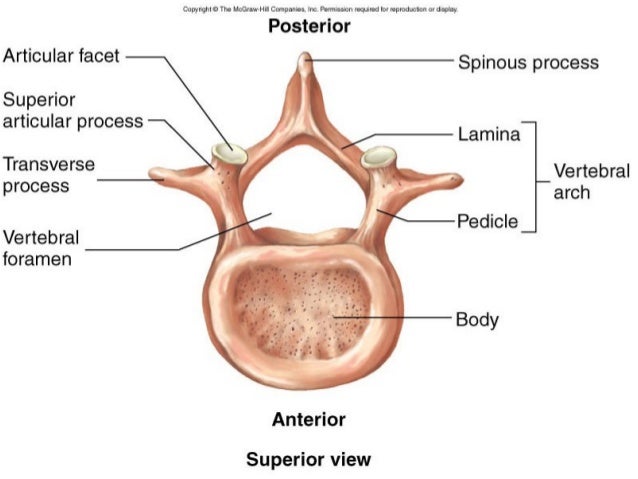
Image result for Vertebra
Side a vertebra

Types of vertebra:

Types of vertebra, thoracic, lumbar and cervical

Atlas (C1) – no body, no spinous process, dens foramen, transverse foramen, anterior and posterior arch and tubercle

Axis (C2) – dens, bifid spine, transverse foramen

Cervical vertebra – bifid spine (C7 is long and not bifid), transverse foramen and horizontal articular facets

Thoracic vertebra – vertical articular facets, heart shaped body, spine long and downwards

Lumbar vertebra – sagittal articular facets, kidney shaped body

Image result for atlas and axis
C1, C2
Parts of atlas
parts of axis

Vertebral ligaments:

  • Anterior longitudinal – prevent hyper extension
  • Posterior longitudinal – prevent hyper flexion
  • Ligamentum flavum – prevent abrupt flexion (between laminas)
  • Interspinous
  • Supraspinous
  • Intertransverse ligament

Vertebral ligaments

  • Static stability of vertebral column – ligaments
  • Dynamic – back muscles ie. iliocostalis, longissimus, spinalis (from lateral to medial)

NB: Vertebral column divided into 3 vertical parallel columns:

vertebral column divided into 3. Anterior, posterior, middle column

Anterior column:

  • Anterior longitudinal ligament
  • Anterior 2/3 of vertebral body
  • Anterior 2/3 of intervertebral disc (annulus fibrosus)

Middle column:

  • Posterior 1/3 of vertebral body
  • Posterior 1/3 on intervertebral disc
  • Posterior longitudinal ligament

Posterior column:

  • Ligament flavum
  • Pedicles
  • Facet joints and articular processes

Scapula:

Image result for scapula labelled
siding the scapula
parts of scapula


Clavicle:

  • Acromial/lateral end is flat
  • Sternal/medial end is thick and round
  • Superior surface is smooth, inferior surface is rough
  • Medial curve protrudes outward

Image result for clavicle labelled
siding clavicle

Unique features of clavicle:

  • Ossifies during week 5 (fetal) and completed at 25 years, others ossify at week 8 and complete at 18-21 years
  • Runs a sigmoid, horizontal course
  • No marrow cavity, core occupied by spongy bone
  • Medial 2/3 ossify endochondrally, lateral 1/3 intramembranously

Functions of clavicle:

  • Hold upper limb away from trunk and increase range of movement such as abduction
  • Transmit weight from upper limbs to axial skeleton
  • Provide attachment for muscles

Clinicals:

  • Fracture between medial 2/3 and lateral 1/3
  • Lateral fragment pulled medial and forward by pectoralis major
  • Injury to brachial plexus and axillary vessels
  • Injury to subclavian artery

Sternum:

Image result for sternum labelled

Sternal angle – angle formed by the junction of manubrium and body of sternum.

Importance: landmark to indicate level at which the 2nd rib joint with the sternum


Humerus:

  • Medial epicondyle more outwards than lateral
  • Lateral side – capitulum and deltoid tuberosity

Humerus labelled


Radius:

  • Anterior surface smooth and concave at lower end
  • Laterally – convex, lateral styloid process
  • Medially – ulnar notch and medial tuberosity
  • Lower end is large

parts of radius
siding the radius


Ulna:

  • Medial styloid process
  • Convex medially

Image result for ulna labelled
siding the ulna


Bones of hand:

Image result for Bones of hand

From thumb to little finger:

  • Trapezius, trapezoid, capitate, hamate
  • Scaphoid, lunate, triquetral, pisiform

Muscle attachment on bones
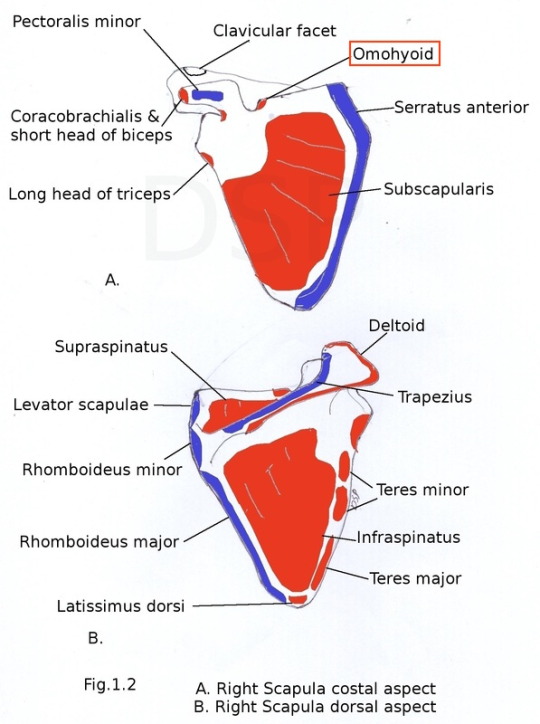
Image result for muscle attachments on scapula

Image result for muscle attachments on clavicle

Muscle attachment on sternum

Image result for humerus muscle attachments

Image result for radius muscle attachments

Image result for radius and ulna muscle attachments

Clinicals:

  • Dropped shoulder – trapezius paralyzed
  • Winged shoulder – serratus anterior paralyzed

Arteries

Flowchart of arteries of upper limb
DentMistry

NB: Same for deep veins of the arm, all deep veins are venae commitantes with the arteries.

(I) Axillary artery – chest, axilla, breast and shoulder joint

  • Continuation of subclavian artery from lateral border of first rib
  • Divided into 3 parts by passing posterior to pectoralis minor:
  1. 1st part – Superior thoracic
  2. 2nd part – Thoracoacromial and lateral thoracic
  3. 3rd part – Anterior circumflex humeral, posterior circumflex humeral, subscapular
  • Continues as brachial artery from inferior border of teres major

(II) Brachial artery – all arm muscles and elbow joint

  • Descends on ventral surface
  • Medial to humerus
  • Median nerve crosses over it from lateral to medial
  • At apex of cubital fossa, divides into radial and ulnar arteries
  • Other branches: profunda brachii (which gives middle and radial collateral), superior and inferior ulnar collateral and humeral nutrient artery

(III) Ulnar artery – anterior forearm muscles

  • Descends obliquely on ulnar side and runs along ulnar border to wrist
  • Deep to pronator teres
  • Deep to superficial and intermediate muscles
  • Lateral to ulnar nerve
  • Superficial to flexor retinaculum
  • Through Hook of Hamate and Guyon’s canal
  • Divides into superficial and deep palmar arch
  • Branches: anterior and posterior ulnar recurrent, common interosseous

(IV) Radial artery – posterior forearm muscles

  • Descends obliquely on radial side and runs along radial border
  • Anterior to pronator teres
  • Winds around head of radius to go posterior
  • Medial to radial nerve
  • Through anatomical snuff box
  • Divides into superficial and deep palmar arch

Veins

Superficial veins of arm:

Flowchart of veins of upperlimb

NB: Cephalic V. used for:

  • Drawing of blood
  • Intravenous injection
  • Venous cutdown

Nerves

Cutaneous innervation of upper limbs:

Cutaneous nerve innervation of upper limbs

Cutaneous innervation of hands, palmer and dorsal

Dermatomes of upper limbs:

dermatomes of upper limbs

Image result for brachial plexus

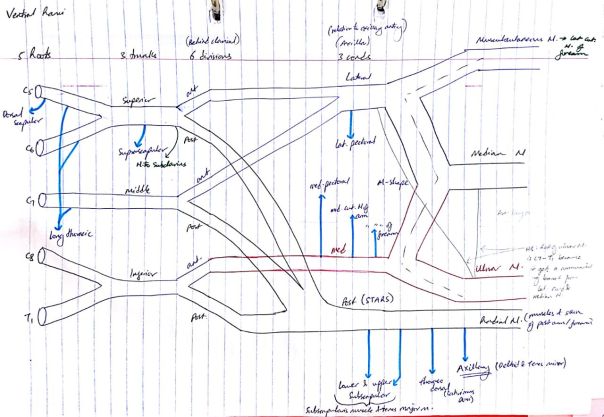
Formation of brachial plexus

(I) Musculocutaneous nerve – anterior arm muscles, lateral forearm skin

  • Roots – C5, C6, and C7
  • At inferior border of pectoralis minor
  • Pierce coracobrachialis muscle
  • Runs between brachialis and biceps brachii
  • Becomes lateral cutaneous nerve of forearm
  • Runs in cubital fossa with cephalic vein

(II) Median nerve – anterior forearm muscles except flexor carpi ulnaris, elbow and wrist joint

  • Roots – C5-T1
  • The 2 cords join in axilla to form median nerve
  • Crosses over brachial artery from lateral to medial
  • Through cubital fossa
  • Between 2 heads of pronator teres
  • Through carpal tunnel
  • Divides into recurrent and palmer digital nerves

Clinical: Carpal tunnel syndrome, hand of Benediction/ monkey hand

Entrapments: Carpal tunnel, cubital fossa, pronator teres heads

(III) Ulnar nerve – elbow joint, flexor carpi ulnaris and flexor digitorum profundus muscles

  • Roots – C8-T1
  • Runs in medial arm
  • Passes posterior to medial epicondyle at elbow
  • Between 2 heads of flexor carpi ulnaris
  • Travels on the ulna side
  • Superficial to flexor retinaculum
  • Through hook of Hamate and Guyon’s canal
  • Divides into superficial and deep branches

Clinical: Ulnar claw, fracture at medial epicondyl

Entrapments: Cubital tunnel, Guyon’s canal, flexor carpi ulnaris 2 heads

(IV) Radial nerve – Posterior arm and forearm muscles and skin

  • Roots – C5-T1
  • Posterior to axillary artery in axilla
  • Posterior to brachial artery
  • Between long and medial head triceps
  • Exists via lower triangular space with profunda artery
  • Runs in radial groove of humerus
  • Pierce lateral intermuscular septum
  • Anterior to lateral epicondyle of humerus
  • Through cubital fossa
  • Winds around neck of radius
  • Penetrates supinator
  • Descends between superficial and deep muscles of the posterior forearm
  • Lateral to radial artery in anatomical snuff box

Clinicals:

  • Injury in axilla/ humerus fracture – elbow, wrist and finger drop
  • Injury in radial groove – wrist and finger drop
  • Injury in radial head fracture – finger drop
  • All have loss of sensation

Entrapments: Axilla, lower triangular space, radial groove, cubital fossa, anatomical snuff box
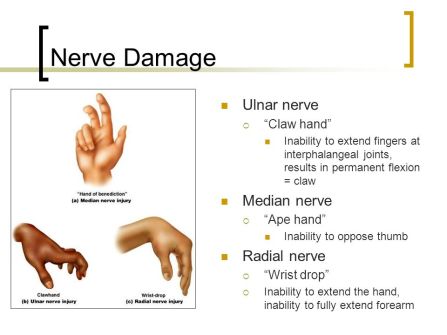
Image result for hand of benediction
claw hand, ape hand, wrist drop

NB:

  • Brachialis muscle supplied by both radial and musculocutaneous nerves
  • Flexor digitorum profundus supplied by both ulnar and median nerves

(V) Axillary nerve – Glenohumeral joint, teres minor and deltoid muscle, skin of superolateral arm

  • Roots – C5-C6
  • Exists axilla via quadrangular space (with posterior circumflex humeral)
  • Posterior division supplies teres minor
  • Anterior division winds around neck of humerus – supplies anterior part of deltoid

Clinicals:

  • Fracture of surgical neck
  • Entrapment in quadrangular space
  • Glenohumeral joint dislocation
  • All this leads to paralysis of deltoid and teres minor and loss of skin sensation

Entrapments: Shoulder dislocations, axilla, quadrangular space


Joints

(I) Glenohumeral/shoulder joint

Classification: Ball and socket synovial

Articular surfaces: Head of humerus and glenoid fossa

Stability factors:

  1. Static: Coracoacromial arch (prevent superior displacement), coracoacromial ligament, glenohumeral ligament
  2. Dynamic: Rotator cuff muscles, deltoid, trapezius

Movements: Flexion, extention, abduction, adduction, medial and lateral rotation

Image result for abduction shoulder joint
Glenohumeral joint
movements

NB: For abduction:

  • 0 – 15 degrees – supraspinatus
  • 15 -90 degrees – deltoid middle part
  • 90 – 120 degrees – infraspinatus, teres minor
  • 120 – 180 degrees – trapezius and serratus anterior

Blood supply: Anterior and posterior circumflex humeral

Nerve supply: Axillary, suprascapular

Clinicals: Due to shallow fossa, pulled anterior and inferior, damages axillary nerve

NB: Glenohumeral joint capsule has opening for biceps tendon


(II) Elbow joint

Classification: Synovial uniaxial hinge

Articular surfaces:

  • Trochlea – trochlea notch on ulna
  • Capitulum – head of radius

Stability factors:

  1. Static: Annular ligament, radial and ulnar collateral ligaments

Image result for Annular ligament, radial and ulnar collateral ligaments
Elbow joint

2. Dynamic: Triceps, biceps, brachialis and radiobrachialis

Movements: Flexion and extension

Blood supply: Elbow anastomosis (written in arteries)

Nerve supply: Musculocutaneous, radial and ulna

Clinicals: Bursitis, dislocation, golfers elbow (medial epicondylitis), tennis elbow (lateral epicondylitis)


(III) Radioulnar joint

Proximal:

Classification: Synovial pivot uniaxial

Articular surfaces: Head of radius, radial notch on ulna

Stability factors: Annular ligament

Movements: Supination and pronation

Nerve supply: Musculocutaneous, median, radial and ulna

Distal:

Classification: Synovial pivot uniaxial

Articular surfaces: Ulna head and ulnar notch on radius

Movements: Supination and pronation

Blood supply: Anterior and posterior interosseous

Nerve supply: Anterior and posterior interosseous

Clinicals: Subluxation of radial head


(IV) Wrist joint

Classification: Ellipsoid synovial

Articular surfaces: Scaphoid, lunate, articular disc and distal end of radius

Stability factors:

1. Static: Joint capsule and ligaments:

  • Palmer radiocarpal
  • Dorsal radiocarpal
  • Ulnar collateral – styloid process to trapezoid and pisiform
  • Radial collateral – styloid process to scaphoid and trapezius

2. Dynamic: Carpal tunnel contents

Image result for wrist joint
Carpal tunnel contents

Movements: Flexion, extension, abduction and adduction

Blood supply: Dorsal and palmer carpal arches

Nerve supply: Median nerve

Clinicals: Anterior lunate dislocation, carpal tunnel syndrome


(V) Sternoclavicular joint

Classification: Synovial saddle

Articular surfaces: Clavicle sternal end, manubrium of sternum, 1st costal cartilage

NB: Covered in fibrocartilage, separated into 2 compartments by articular disc

Stability factors: Anterior and posterior sternoclavicular ligament, interclavicular ligament, costoclavicular ligament

Image result for sternoclavicular joint

Clinicals: Anterior and posterior dislocations


(VI) Acromioclavicular joint

Classification: Plane synovial

Articular surfaces: Lateral end clavicle and acromion

NB: Covered in fibrocartilage, separated into 2 compartments by articular disc

Stability factors: Acromioclavicular ligament

Movements: Anterior and posterior

Clinicals: Suspend weight from upper limb from clavicle, dislocation

Acromioclavicular joint


Others

1. Intervertebral disc – hyalin cartilage, shock absorber, hold adjacent vertebra together, distributes weight transmission

Clinicals: prolapsed IVD, herniation of IVD

intervertebral disc
herniated intervertebral disc


2. Primary curvature – Kyphosis – thoracic and sacral

Secondary curvature – Lordosis – Cervical and lumbar

Image result for primary and secondary curvatures of the spine

Clinical: Scoliosis

Types of scoliosis


3. Mammary glands:

Extent:

Medially                  Laterally

               2nd rib

Sternum ———-Mid axillary line

                6th rib

  • Axillary tail extends into axilla laterally
  • Nipple at 4th intercostal space

Relations: overlies pectoral fascia covering 4 muscles

  1. Pectoralis major
  2. Serratus anterior
  3. External abdominis aponeurosis
  4. Rectus abdominis

Separated from fascia by retromammary space with loose connective tissue. This is the basis for free mobility of the breast chest wall

Base of breast ⇒ Retromammary space ⇒ Pectoral fascia

Blood supply:

  • Perforationg branches of lateral thoracic
  • Perforating branches of posterior intercostal arteries
  • Superior thoracic
  • Thoracoacromial

Nerve supply: 4th to 6th intercostal nerves

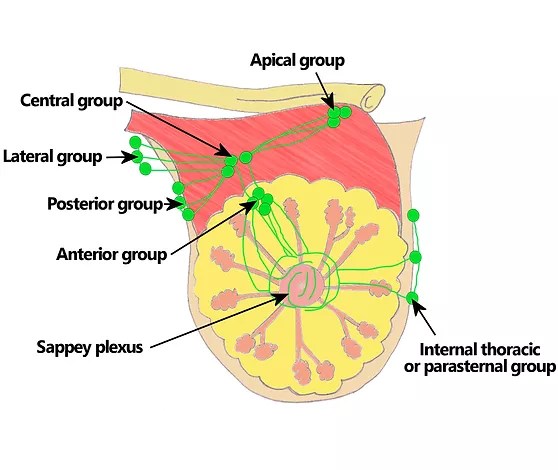
Lymphatic drainage:

  • Internal mammary/ Internal thoracic
  • Axillary (anterior, posterior, lateral and central)
  • Supraclavicular nodes

Lymphatic drainage of mammary glands

Clinicals:

  • Breast cancer – spread via lymphatics/venous channels. Due to axillary tail, axillary lymph nodes in breast cancer examined – swollen axillary nodes
  • Mammography – radiography of breasts
  • Masectomy – breast removal
  • Mastities – infection through nipple during lactation
  • Peau d’orange – ridges due to edema, inverted nipple

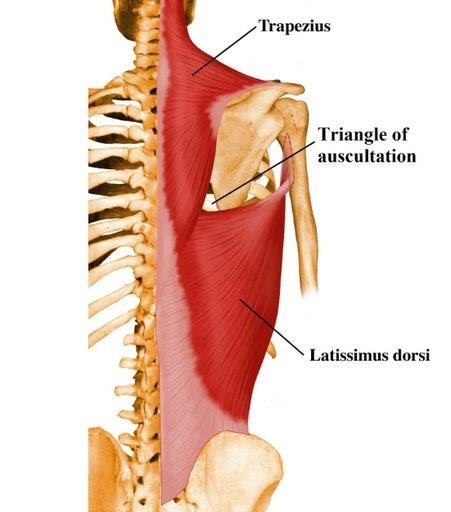
4. Triangle of auscultation – hear respiratory sounds

  • Trapezius
  • Scapular border
  • Latissimus dorsi

Image result for triangle of auscultation


5. Deltopectoral triangle:

Image result for deltopectoral triangle

Contents: Cephalic vein and thoracoacromial branch


6. Clavipectoral fascia – fills gap between pectoralis minor and clavicle

structures piercing clavipectoral fascia


7. Rotator cuff:

  • Supraspinatus
  • Infraspinatus
  • Subscapularis
  • Teres minor

rotator cuff muscles

Clinicals:

  • Rotator cuff tendinitis (inflamed tendons)
  • Rotator cuff tear (supraspinatus)

8. Spaces of the arm:

Image result for spaces of the arm

  1. Quadrangular space – Axillary nerve and posterior humeral circumflex vessels
  2. Upper triangular space – Circumflex scapular vessels
  3. Lower triangular space – Radial nerve and profunda brachii vessels

Clinicals: Entrapment syndrome


9. Axilla:

Image result for axilla
Boundaries of axilla

Boundaries:

  1. Anterior wall: Pec minor, pec major and clavipectoral fascia
  2. Medial wall: Serratus anterior, intercostal muscles, 1-4 ribs
  3. Lateral wall: Coracobrachialis, short head biceps brachii
  4. Posterior wall: Subscapularis, teres major, latissimus dorsi
  5. Base: Skin and fascia
  6. Apex:
  • Anterior – clavicle
  • Posterior – superior border scapula
  • Medial – 1st rib

Contents:

  • Axillary artery and vein
  • Brachial plexus cords
  • Axillary lymph nodes
  • Axillary tail of breasts

Clinicals: Aneurysms, lymphomas


10. Cubital fossa:

Boundaries:

Image result for Cubital fossa:

Contents: Medial to lateral

  • Median nerve
  • Brachial artery
  • Biceps brachii tendon
  • Radial nerve

Mnemonic: My Bottoms Turned Red

Clinicals: 

  • Brachial pulse
  • Venepuncture – median cubital vein
  • Cubital fossa syndrome

11. Carpal tunnel:
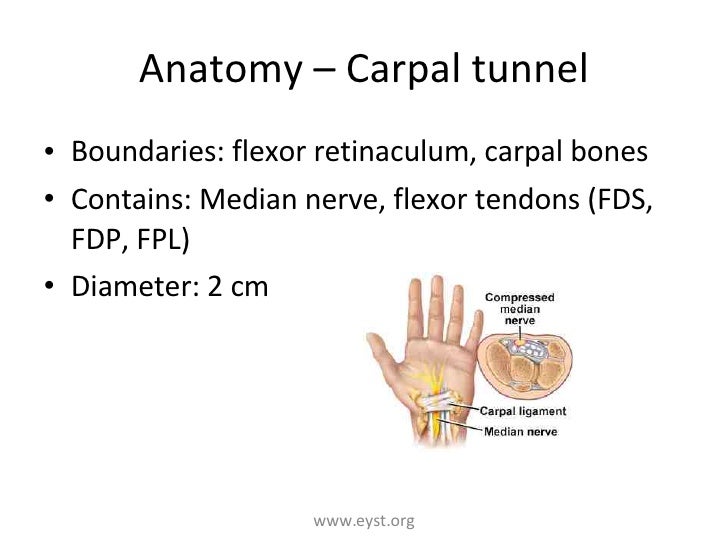
Image result for carpal tunnel boundaries, contents and diameter

Anterior relations – Ulnar nerve and artery, palmaris longus tendon

Clinicals: Carpal tunnel syndrome – compressed median nerve, swollen tendons, thickened ligaments. Feelings of numbness and tingling


12. Anatomical snuff box:

Boundaries:
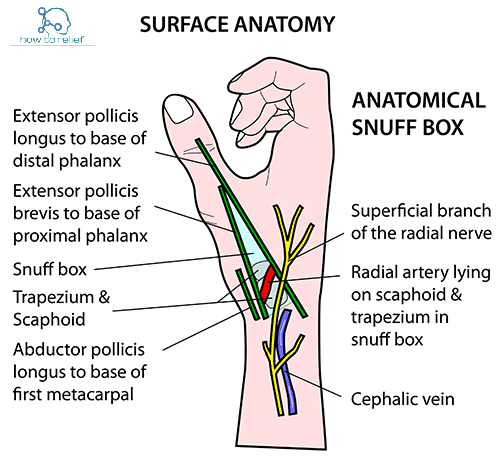
Boundaries of anatomical snuff box

Floor – Scaphoid and trapezium

Contents:

  • Radial artery
  • Branch of radial nerve
  • Cephalic vein

Clinical: Scaphoid fracture (arthritis, avascular, necrosis)


These are summarized notes from various sources, mainly TeachMeAnatomy and Wikipedia

Anatomy of Lower Limbs

 Bones and how to side them

Pelvis:

To side pelvis, look at the ischial tuberosities, obturator foramen and acetabular notch

Side the pelvis bone
Hip joint
Parts of pelvis labelled
Side the pelvis bone
Parts of pelvis bone
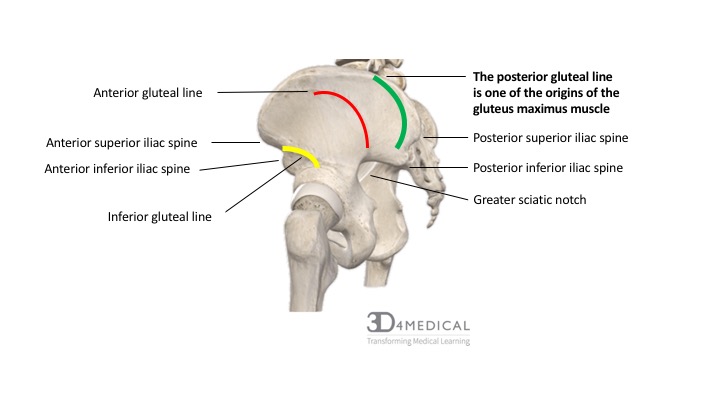
Pelvis bone inferior, middle and superior gluteal line
Parts of pelvis bone, hip bone

Femur:

  • Posterior: Linea aspera, intertrochanteric crest
  • Medial condyle larger and downwards, adductor tubercle on medial side
Side the femur
Parts of femur

NB: Blood supply to head of femur – Nutrient artery, artery in ligamentum teres, medial and lateral circumflex arteries


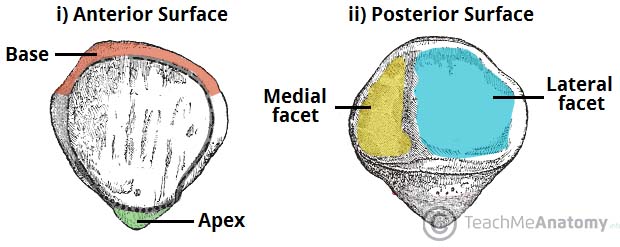
Patella:

  • Ant: rough surface
  • Post: smooth, lateral facet larger
Side the patella anterior and posterior
Parts of the patella

Tibia:

  • Anteriorly is tibial tuberosity
  • Medial malleolus
  • Anterior border sharpest
Side tibia and fibula
Parts of the tibia
Parts of the fibula

Fibula:

  • Lateral malleolus
  • Head has styloid process and articular facet on lateral head

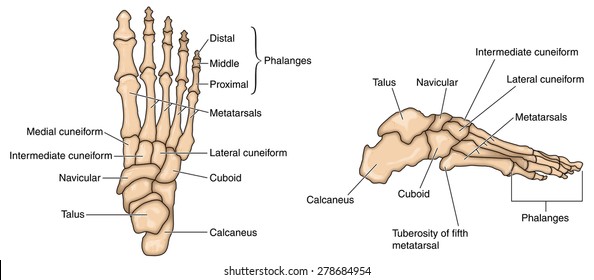
Bones of foot:

Bones of foot, tarsals, talus, calcaneus
Side the foot bones

Clinicals: club foot, flat foot, hammer toe, bunion


Talus:

  • On lateral side is a bulge as seen from above
  • Medial surface has comma shaped articular facet
  • Planter surface has deep groove
  • Anterior surface has head

Cuboid:

  • Proximally concave
  • Superiorly broad and rough
  • Inferiorly oblique groove and ridge behind the groove
  • Laterally notch
  • Medially oval facet and broad

Calcaneus:

  • Posterior part rough and large
  • Lateral surface straight, medial surface concave


Muscle attachment on bones

Image result for muscle attachments on pelvis
Insertion and origin of muscles on Pelvis bone
Image result for muscle attachments on femur
Insertion and origin of muscles on femur bone
Image result for muscle attachments on femur
Image result for muscle attachments on tibia and fibula
Insertion and origin of muscles on tibia and fibula
Anterior
Image result for muscle attachments on tibia
Insertion and origin of muscles on tibia and fibula
Posterior

Arteries

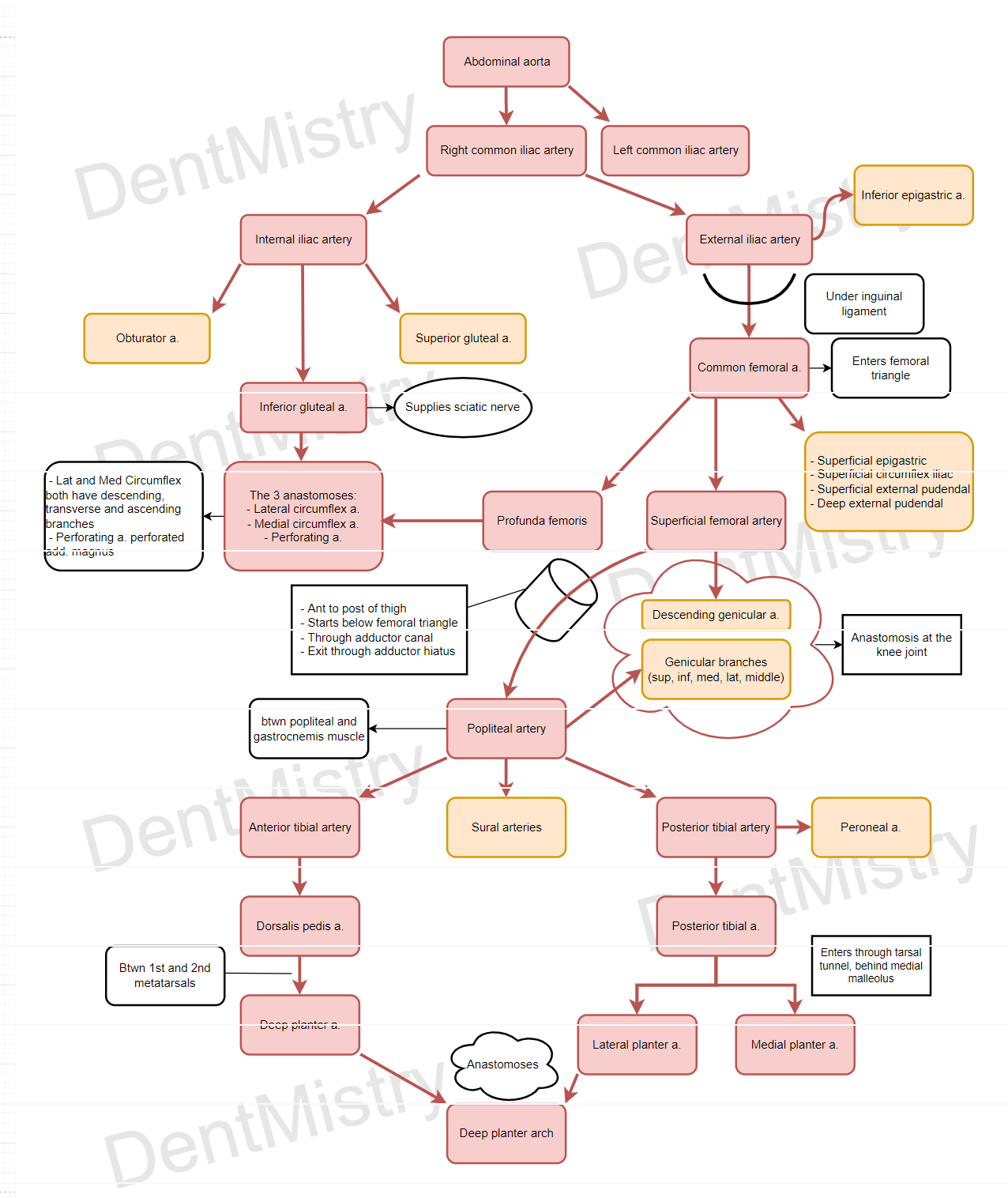
Arteries of lower limb
Flowchart showing each artery from abdominal aorta 
Common iliac artery, internal iliac artery, external iliac artery, profunda femoris, popliteal artery, anterior tibial artery, posterior tibial artery, superficial femoral artery

(I) Anastomosis

Trochanteric anastomosis – SLIM

  • Superior gluteal a.
  • Lateral circumflex
  • Inferior gluteal
  • Medial circumflex

Cruciate anastomosis – LIMP

  • Lateral circumflex
  • Inferior gluteal
  • Medial circumflex
  • 1st perforator

Longitudinal anastomosis – perforators

Longitudinal anastomosis, femoral artery, perforating arteries

(II) Femoral artery – anterior thigh

  • From external iliac artery
  • Between ASIS and pubic symphysis
  • Posterior to inguinal ligament
  • Anterior to psoas major muscle

5 branches – Superficial circumflex iliac, superficial epigastric, superficial external pudendal, deep external pudendal and profunda femoris – lateral and medial circumflex and 1-4 perforators

  • Becomes superficial femoral artery
  • Descends through femoral triangle and adductor canal (in here give descending genicular artery)
  • Through adductor magnus hiatus – becomes popliteal artery

(III) Popliteal artery

  • Through adductor hiatus
  • Descends popliteal fossa
  • Between femoral condyles
  • Superficial to popliteus muscle
  • At lower border of popliteus muscle branches into anterior and posterior tibial arteries
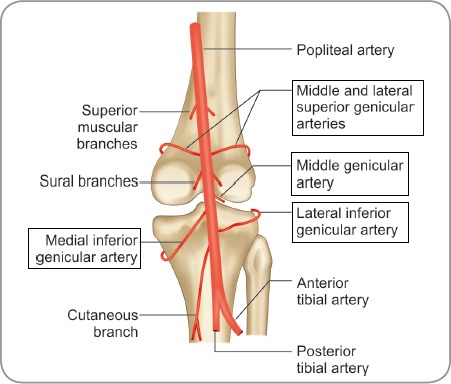
  • Other genicular branches: (supply knee joint)
Knee anastomoses, genicular artery

Clinicals – muscles compress artery

(IV) Anterior tibial artery – anterior leg and lateral leg

  • Origin from lower border of popliteus muscle
  • Passes anteriorly by piercing upper end of interosseous membrane
  • Descends between tibialis anterior and extensor digitorum longus
  • Below inferior extensor retinaculum
  • Forms dorsal pedis artery – which forms deep planter artery

(V) Posterior tibial artery – posterior leg

  • Gives off a peroneal artery
  • Runs in posterior compartment of leg between deep and superficial muscles
  • Enters tarsal tunnel behind medial malleolus
  • Divides into medial and lateral planter arteries

(VI) Obturator artery – medial thigh


Veins

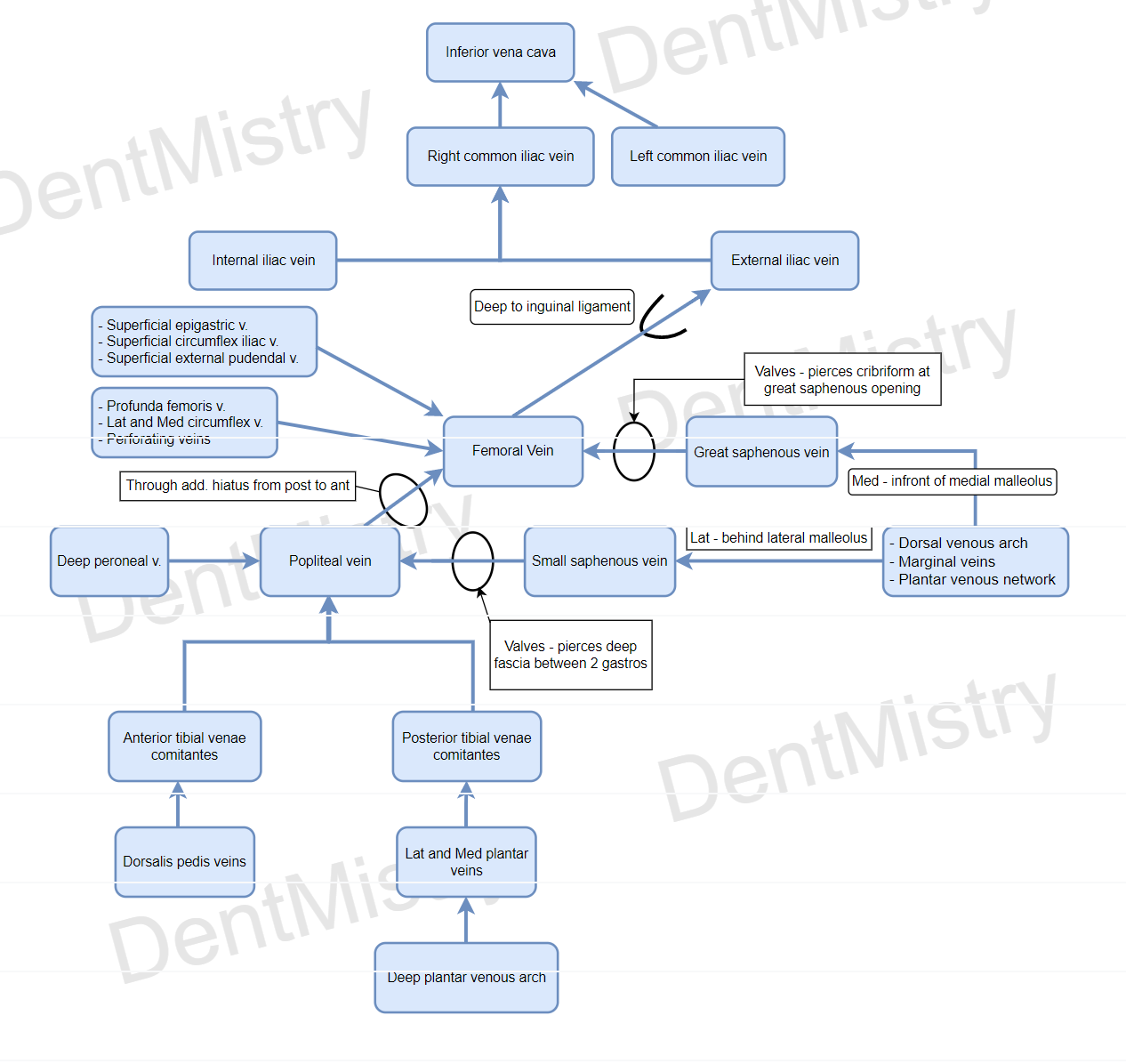
Veins of lower limbs
Flow chart of veins of lower limb
Inferior vena cava, external iliac vein, internal iliac vein, femoral vein, great saphenous vein, small saphenous vein, popliteal vein
anterior tibial venous comitantes, posterior tibial venous comitantes, dorsal pedis veins

(I) Great saphenous vein

  • Drains dorsal vein of big toe and dorsal venous arch of foot
  • Infront of medial malleolus
  • runs up medial side of leg
  • Courses anteriorly
  • Pierce cribriform fascia at saphenous opening – joins femoral vein in femoral triangle

(II) Small saphenous vein

  • Drains dorsal vein of small toe and dorsal venous arch of foot
  • lateral aspect of foot behind lateral malleolus
  • Runs up posterior aspect of leg
  • Pierces deep fascia between 2 gastrocnemius
  • Drain into popliteal vein

Clinicals: 

  1. Varicose veins – incompetent valves of superficial veins
  2. Grafts – Coronary bypass
  3. Venous cutdown – infuse fluid in dehydrated children at medial malleolus


Nerves

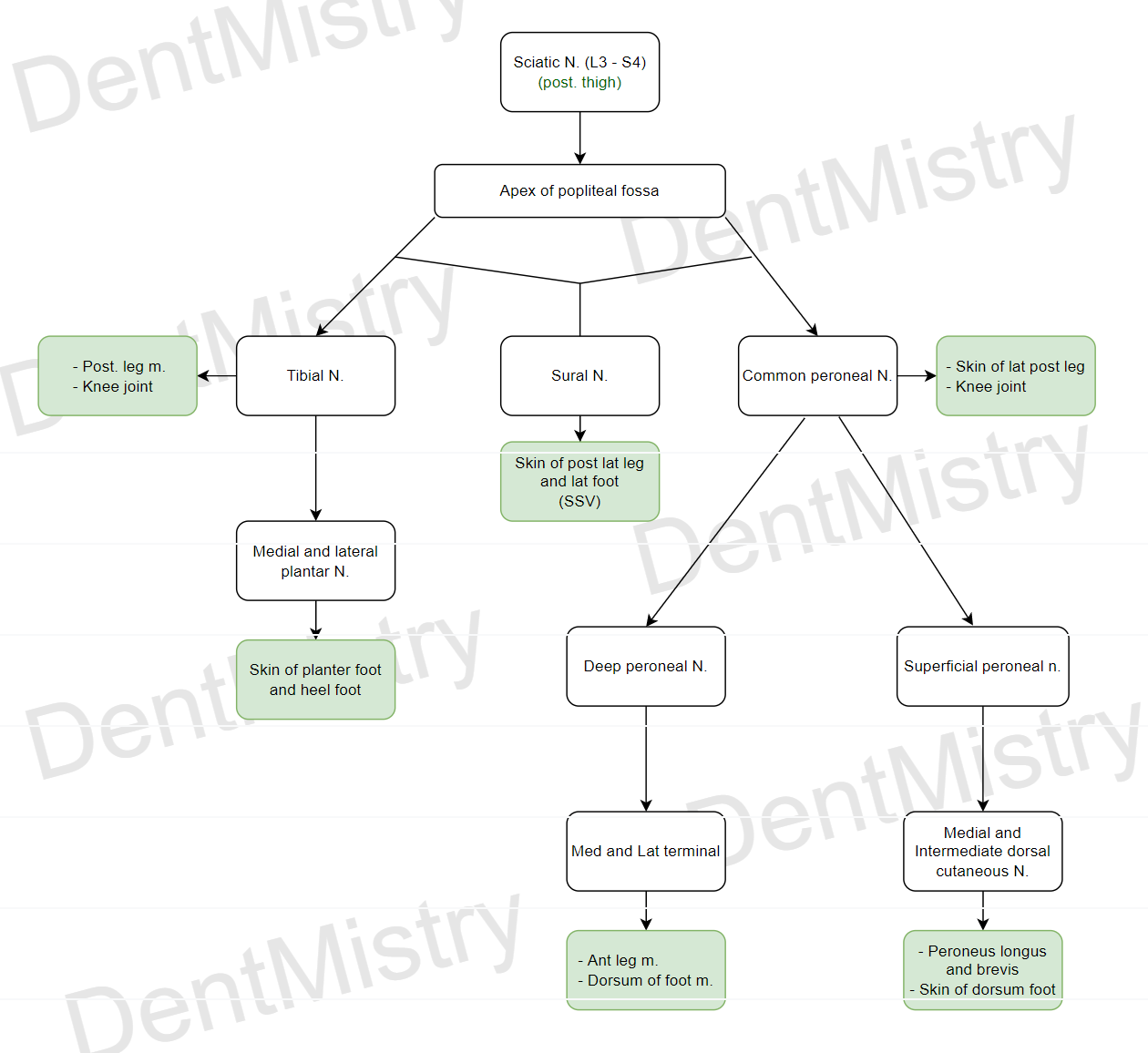
Nerves of lower limb
Flow chart of nerves of lower limb
sciatic nerve, tibial nerve, sural nerve, common peroneal nerve
planter nerve, deep peroneal nerve, superficial peroneal nerve
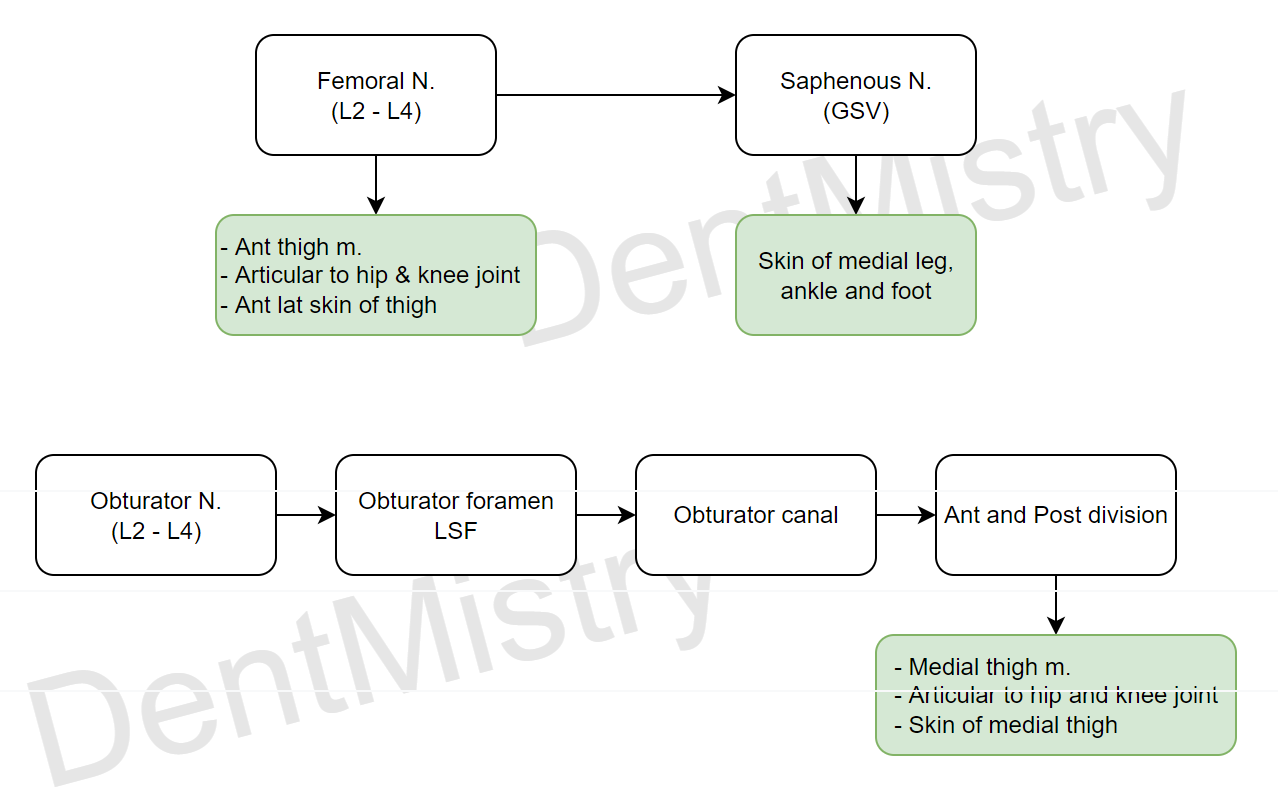
Femoral nerve pathway flowchart
Obturator nerve pathway, flowchart
Saphenous nerve
Femoral nerve distribution
Saphenous nerve distribution
Obturator nerve distribution

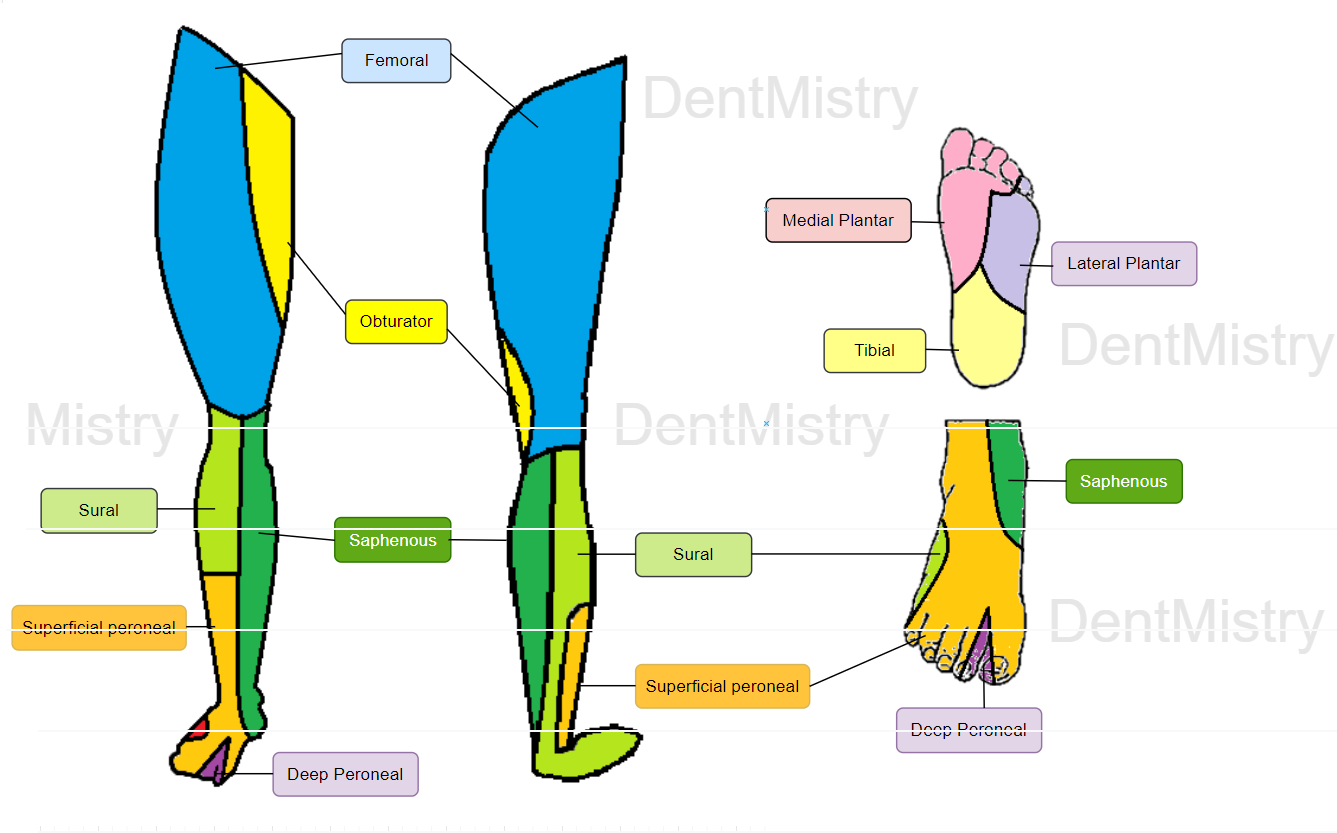
Cutaneous Innervation:

Cutaneous nerve distribution anterior and posterior lower limbs
planter cutaneous innervation
Colour coded lower limbs innervation labelled

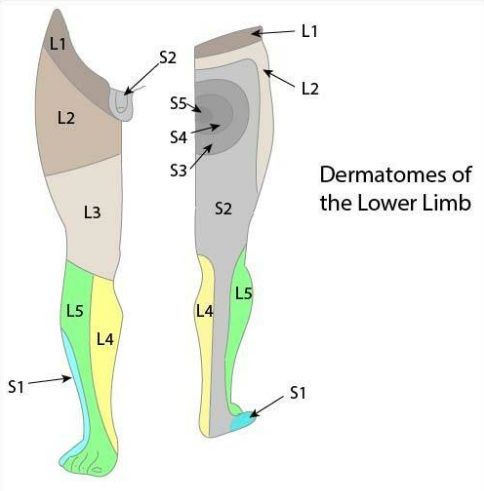
Dermatomes:

Dermatomes of lower limb
L1 to S3

(I) Sciatic nerve: L4-S3 – posterior thigh

Course:

  • Passes between imaginary line between PSIS to ischial tuberosity to gluteal tuberosity
  • Through infrapiriform compartment, greater sciatic foramen
  • Deep to gluteus maximus muscle
  • Descends posterior thigh
  • Superficial to adductor magnus
  • Deep to biceps femoris
  • At apex of popliteal fossa divides into tibial nerve and common peroneal nerve

Supplies – posterior thigh

Blood supply – inferior gluteal artery, perforators of profunda femoris

Clinical:

  • Piriformis foramen syndrome
  • Injury by wound/femur dislocation – muscles below knee paralyzed
  • Foot drop – peroneal nerve
  • Sciatic hernia – intestines through GSF

(II) Tibial nerve (accompanies posterior tibial artery) – posterior leg

  • Contributes to sural nerve
  • Runs in posterior compartment of leg between deep and superficial muscles
  • Enters tarsal tunnel behind medial malleolus
  • Divides into medial and lateral planter nerves

(III) Common peroneal nerve (damaged – foot drop, called policeman’s nerve)

  • Descends obliquely on lateral side of popliteal fossa (along medial margin of biceps femoris)
  • Winds around head of fibula
  • Deep to peroneus longus – divides into deep peroneal nerve and superficial peroneal nerve

(IV) Deep peroneal nerve – anterior leg

  • Runs on anterior surface of interosseous membrane with anterior tibial artery
  • At ankle joint, goes through extensor retinaculum, divides into medial and lateral terminal branches

(V) Superficial peroneal nerve – lateral leg

  • Lateral compartment of leg
  • Superficial to peroneus brevis
  • Pierces deep fascia to become cutaneous
  • Divides to form medial and intermediate dorsal cutaneous nerve

(VI) Sural nerve

  • Between medial and lateral gastrocnemius muscles, pierces fascia
  • Descends with small saphenous vein
  • Behind lateral malleolus
  • Runs in lateral foot

(VII) Femoral nerve: L2-L4 – anterior thigh

  • From lumbar plexus
  • through psoas major muscle
  • Behind inguinal ligament
  • Through femoral triangle outside sheath
  • Splits into anterior and posterior divisions
  • Terminal branch – saphenous nerve

(VIII) Saphenous nerve

  • Descends through adductor canal with femoral artery and vein
  • Pierces fascia, descends with great saphenous vein
  • Goes through flexor retinaculum
  • Runs in medial foot

(IX) Obturator nerve – medial thigh


Joints

(I) Hip joint

Classification: multiaxial ball and socket

Articular surfaces: head of femur and acetabulum notch

Stability factors:

  1. Static: Joint capsule, labrum, depth of acetabulum, ligaments (iliofemoral, pubofemoral and ischiofemoral)
  2. Dynamic: gluteus medius, gluteus minimus, iliopsoas and piriformis

Movements: flex, extend, adduct, abduct, medial rotation, lateral rotation

Blood supply: trochanteric anastomosis and nutrient artery

Nerve supply: femoral, obturator, sciatic and superior gluteal

Clinicals: hip joint dislocations, psoas bursa and femoral fractures


(II) Knee joint – largest joint, lined with hyaline cartilage

Classification: synovial modified hinge joint (condylar and sellar (between femur and patella))

Articular surfaces: patella and condyles of femur and tibia

Stability factors:

  1. Static:
  • Joint capsule
  • Pateller retinaculum (extensions of aponeurosis of vasti medialis and lateralis on each side of patella)
  • Intercondylar eminence
  • Pateller ligament (to tibial tuberosity)
  • Anterior and posterior cruciate ligaments
  • Tibial and fibular collateral (resist valgus instability)
  • Bursa – semimembranosus, suprapateller, popliteal

2. Dynamic: iliotibial tract, semimembranosus and semitendinosus muscle

Movements: flex, extend, medial and lateral rotation

Blood supply: genicular anastomosis and descending genicular artery

Nerve supply: femoral, obturator, tibial and common peroneal

Clinicals:

  • Ligament tears
  • Housemaids bursities – prepateller
  • Clergymans bursities – infrapateller
  • Unhappy triad – medial collateral, medial menisci and anterior crutiate damaged
  • Pateller dislocation – laterally
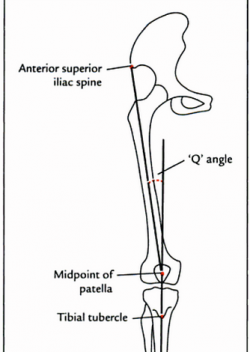
  • Q angle:
Image result for q angles of the knee

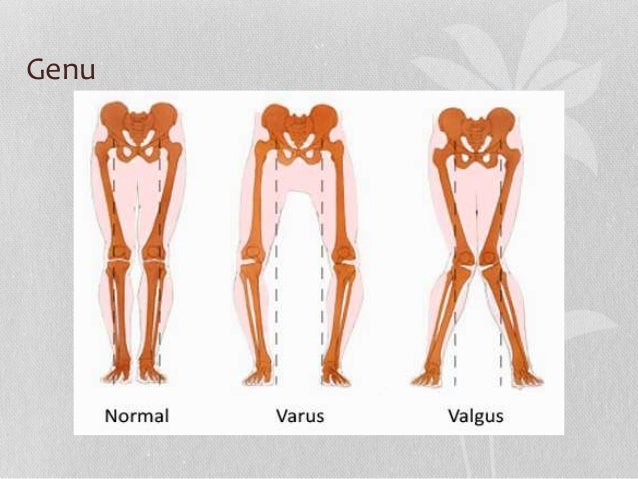
Atypical Q angles

Image result for coxa vara, valgus
atypical Q angles

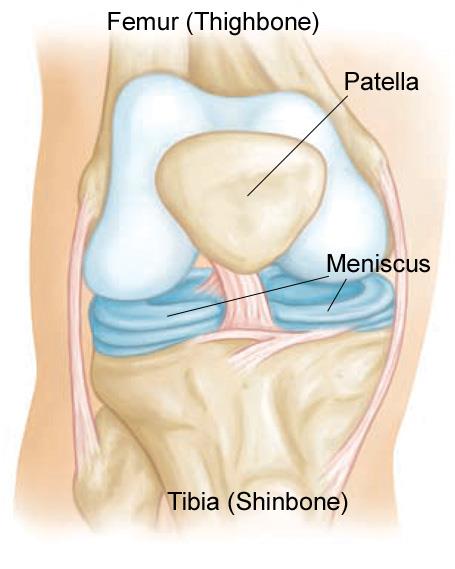
NB: Menisci – fibrocartilage structure. Acts as shock absorber, load transmission, proprioception, produce synovial fluid, protect articular cartilage

Meniscus Tears - OrthoInfo - AAOS
patella

NB: Tibia and fibula have a syndesmosis joint and therefore are immovable and are joint by connective tissue. Even radius and ulna


(III) Ankle joint

Classification: synovial hinge joint

Articular surfaces: tibia, fibula and trochlea of talus

Stability factors:

  1.  Static: deltoid ligament, tibiofibular transverse ligament, anterior and posterior talofibular ligament, calcaneofibular ligament
  2. Dynamic: tendons of anterior and posterior leg muscles

Movements: dorsiflexion and planterflexion

Blood supply: malleolar branches of anterior and posterior tibial arteries and peroneal artery

Nerve supply: tibial and deep peroneal

Clinicals:

  • Ankle sprains – lateral ligament weaker so inversion
  • Potts fracture – eversion, breaks lateral malleolus


Others

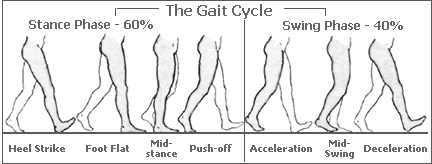
  1. Walking phase:
Image result for walking phase

2. Venous return in lower limbs: Valves, muscular pumps, venae comitans

Image result for venae comitantes

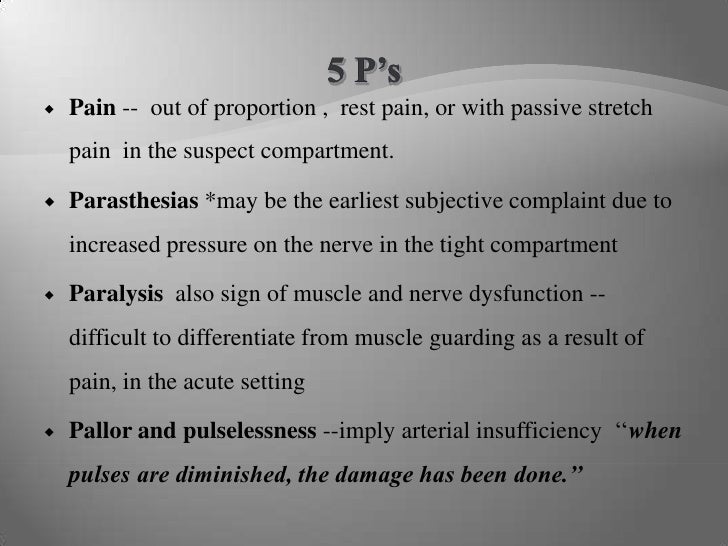
3. Compartment syndrome:

Image result for compartment syndrome the 5 p

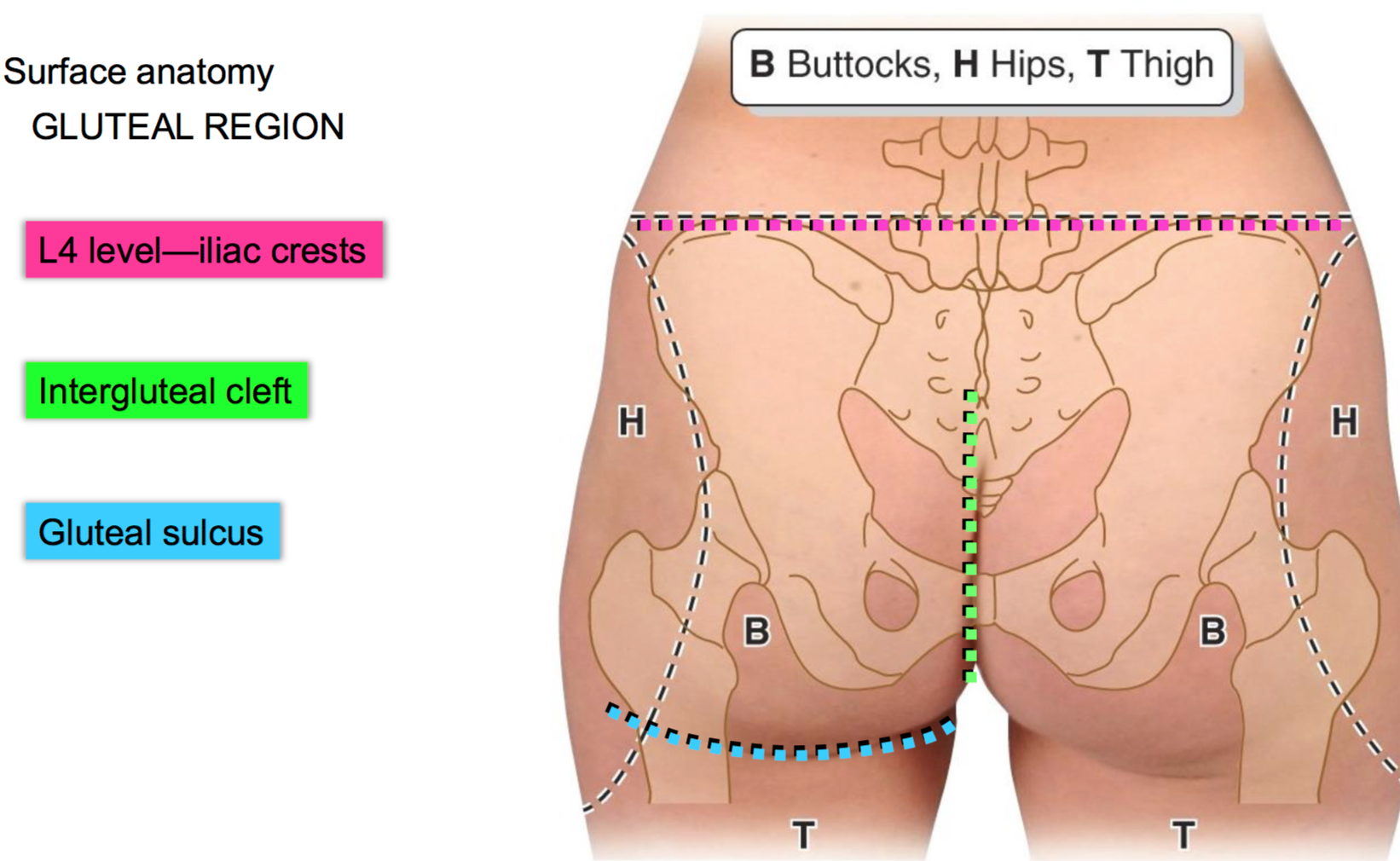
4. Extents of gluteal region:

Extents of gluteal region
iliac crest, intergluteal cleft, gluteal sulcus

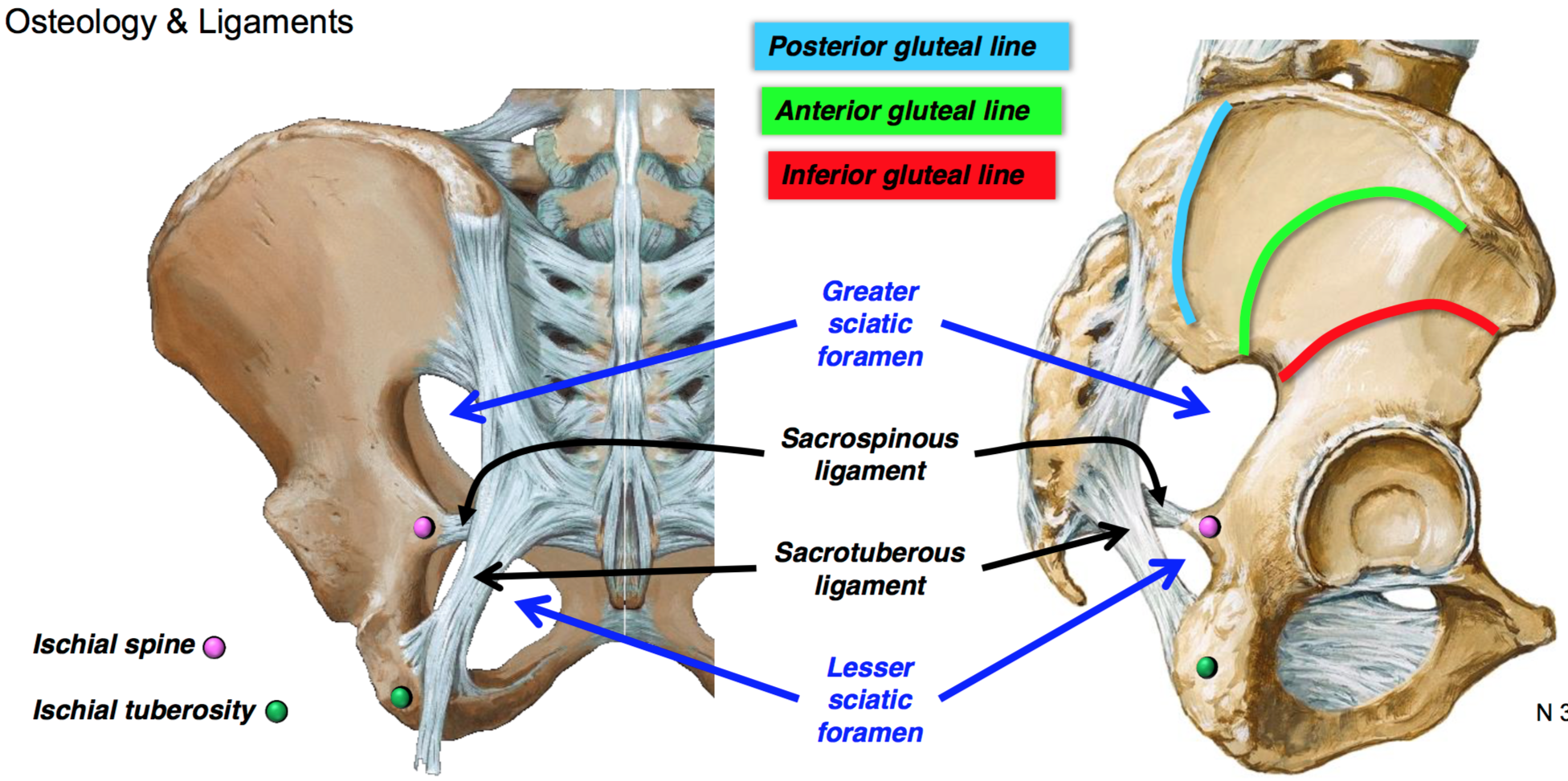
5. Sacrospinous ligament and sacrotuberous ligament form:

(I) Greater sciatic foramen – which piriformis muscle divides into:

  • Suprapiriformic – superior gluteal A,V,N
  • Infrapiriformic – inferior gluteal A,V,N, pudendal nerve and sciatic nerve

(II) Lesser sciatic foramen – Pudendal nerve, nerve and tendon of obturator internus

Greater sciatic foramen
Lesser sciatic foramen
Sacrospinous ligament
Sacrotuberous ligament

6. Popliteous muscle – Tibia fixed, rotates femur laterally. Femur fixed, rotated tibia medially


7. Fascia lata:

Attachments:

  • Superiorly – ASIS, sacrum, coccyx, iliac crest
  • Inferiorly – Bones around knee

Modifications: Iliotibial tract, saphenous opening, cribriform fascia, intermuscular septa

Functions:

  • Muscle attachments
  • Compartmentalize
  • Enclose thigh muscles – less energy used

Clinicals: Fascia lata grafts, compartment syndrome, muscular hernia if fascia cut


8. Saphenous opening – covered by cribriform fascia

Structures passing through: small saphenous vein, superficial epigastric artery, superficial external pudendal

Formed by: Cribriform fascia (roof) and falciform margin


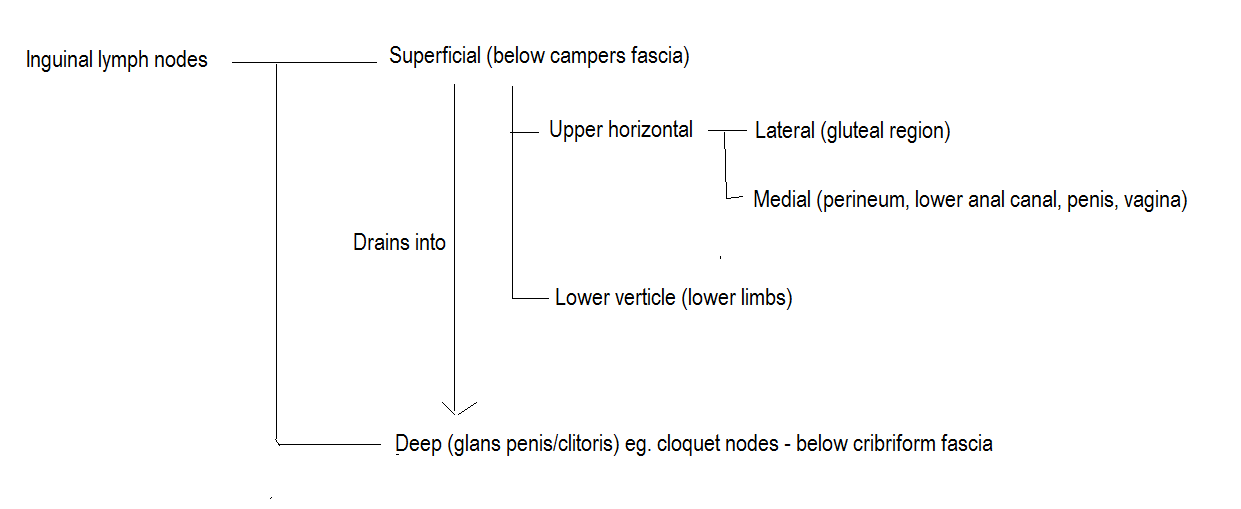
9. Inguinal lymph nodes

Inguinal lymph nodes drainage

10. Iliotibial tract: from iliac crest to lateral patella and lateral condyles

Function: muscle attachment, stabilize lateral knee, maintain hyperextended knee position

Clinical: iliotibial band syndrome – lateral knee pain


11. Angle of declination

Angle of declination femur
coxa vara, coxa valgus
Image result for coxa vara

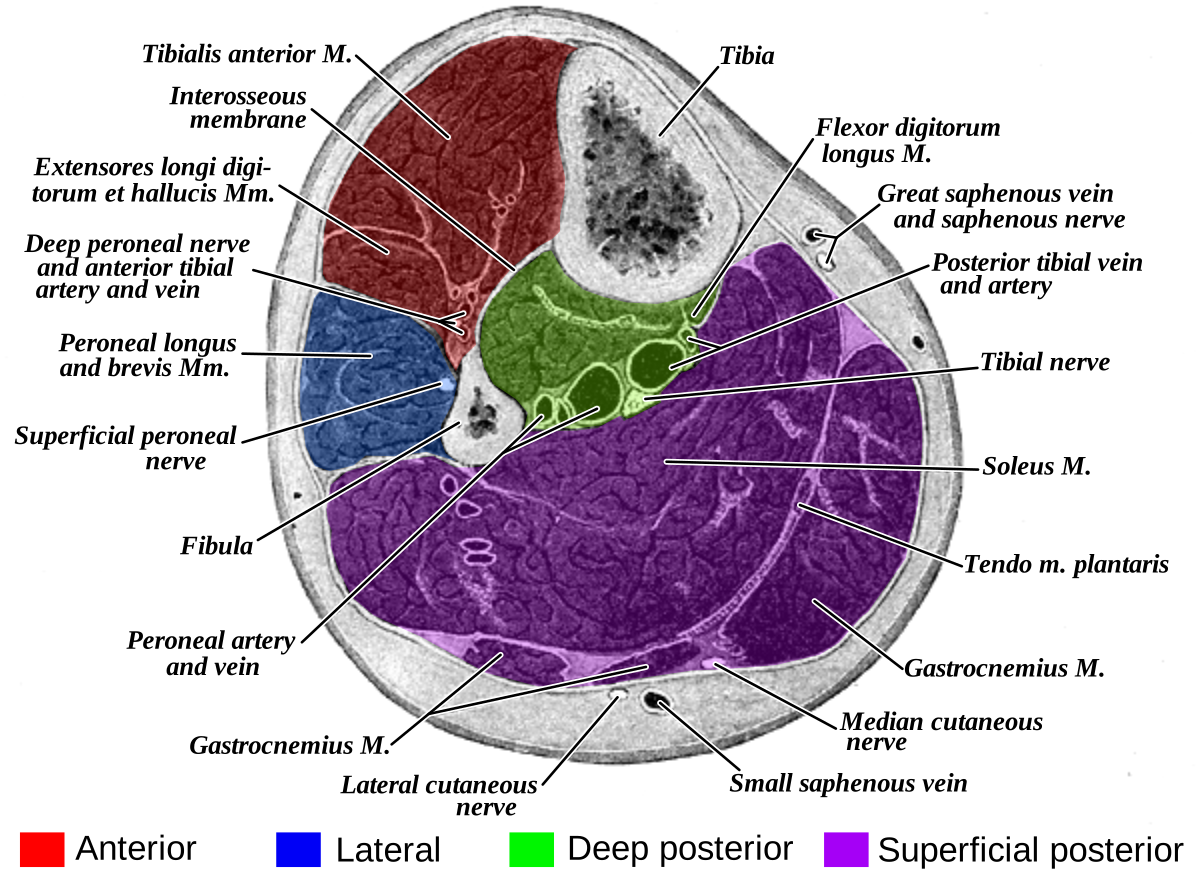
12. Leg compartments 

Fascial compartments of leg - Wikipedia
anterior, posterior, lateral
Illustration of the compartments of the lower leg, as well as the ...

13. Triceps surae – gastrocnemius and soleus muscle. Blood supply- sinusoidal

Tendon achilles : blood supply – water shed


14. Pes anserinus – conjoined tendons of sartorius, gracilis and semimembranosus insert on upper medial tibia


15. Tendons from medial to lateral going through the extensor retinaculum:

  • Tom – tibialis anterior
  • Has – Extensor hallucis longus
  • A – Anterior tibial artery
  • Very – vein
  • Nice – deep peroneal nerve
  • Dog – extensor digitorum longus
  • Pet – peroneus tertius

16. Tarsal tunnel contents from medial to lateral

  • Tom – tibialis posterior
  • Dug – flexor digitorum longus
  • A – posterior tibial artery
  • Very – vein
  • Narrow – tibial nerve
  • Hole – flexor hallucis longus

Clinical: tarsal tunnel syndrome – compressed tibial nerve


17. Popliteal fossa:

Boundaries:

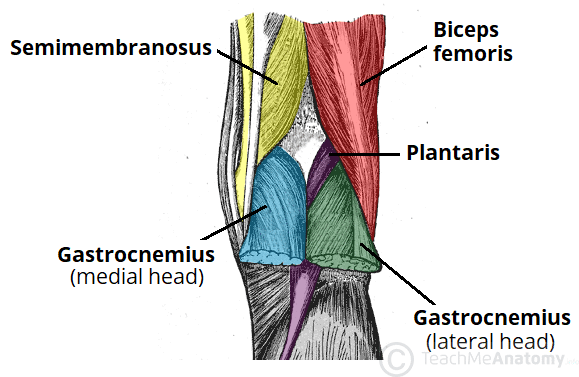
The Popliteal Fossa - Borders - Contents - TeachMeAnatomy
gastrocnemius, semimembranous, bicep femoris, plantaris
  • Roof – skin and fascia
  • Floor – knee joint capsule, popliteus muscle

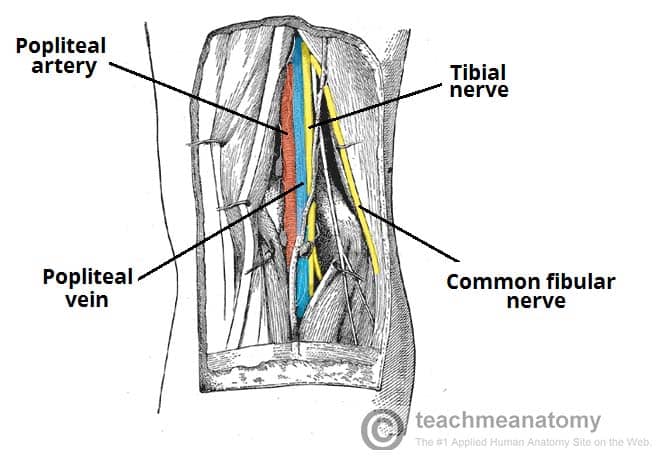
Contents:

The Popliteal Fossa - Borders - Contents - TeachMeAnatomy
popliteal artery, tibial nerve, common fibular nerve, popliteal vein

Clinical: Baker’s cyst (semimembranous bursa)


18. Femoral triangle:

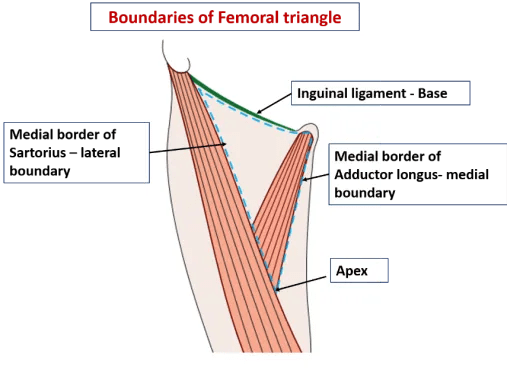
Boundaries:

Boundaries of femoral triangle, medial base apex lateral
  • Roof – skin and fascia
  • Floor – iliopsoas, adductor longus and pectineus

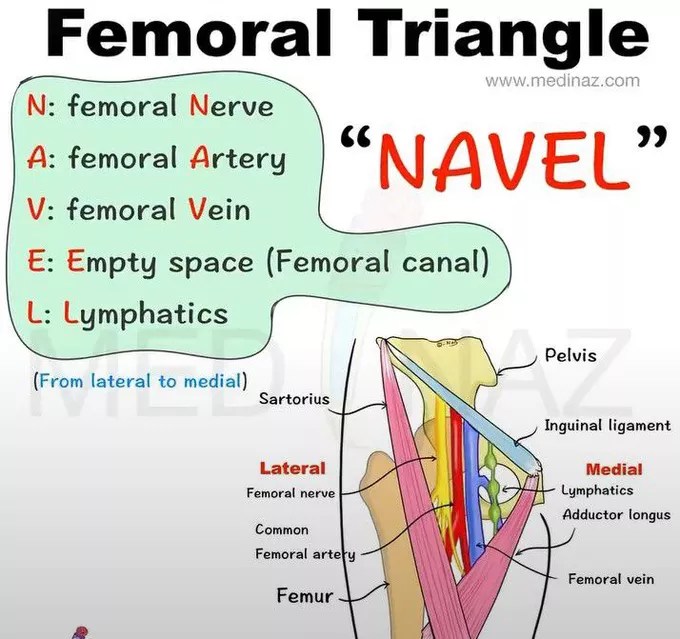
Contents:

  • Femoral ring and sheath
  • Femoral artery, genitofemoral nerve and  femoral vein (in the sheath)
  • Femoral nerve
  • Inguinal lymph nodes
Contents of femoral triangle 
NAVEL

Clinicals: femoral hernia, enlarged lymph nodes


19. Femoral ring:

Image result for femoral ring contents and boundaries

Formation:

  • Anteriorly – Fascia transversalis
  • Posteriorly – Fascia iliacus

Clinical: femoral hernia


20. Adductor canal

Boundaries:

Image result for adductor canal boundaries

Contents:

  • Femoral artery and vein
  • Descending genicular artery
  • Nerve to vastus medialis
  • Saphenous nerve

Clinical: Adductor canal compression syndrome (hypertrophy of muscles)


These are summarized notes from various sources, mainly TeachMeAnatomy and Wikipedia

Development of external genital organs

Indifferent stage

This development occurs between gestational weeks 8 and 12.

  • 2 mesenchymal cloacal folds form on either side of cloacal membrane
  • The 2 cloacal folds fuse infront of the cloacal membrane to form cloacal eminence
  1. Cloacal eminence enlarges – forms genital tubercle
  2. Cloacal membrane divides into urogenital membrane and anal membrane
  3. Cloacal fold divides into genital fold and anal fold
  • Another pair of elevation forms on either side of genital fold – genital swelling
Image result for cloacal folds
development of external genital organs

In females:

  • Genital tubercle – clitoris
  • Genital fold – labia minora
  • Genital swelling – 2 labia majoras

In males:

  • Genital tubercle – elongates to form phallus
  • Genital fold – elongates to form urethral groove which forms urethral plate and then urethral canal
  • Genital swelling – 2 scrotal swellings, fuse – scrotum

Congenital anomalies:

  1. Absence of penis/clitoris – no genital tubercle develops
  2. Small penis – underdeveloped genital tubercle
  3. large clitoris – overdeveloped genital tubercle
  4. Divided scrotum – failure of genital swelling to fuse
  5. False hermaphrodite – gonads are of one sex, external genitalia are of opposite sex

Development of genital system

Indifferent gonads

  • A genital ridge forms from intermediate mesoderm (medial to mesonephros) – forms stroma of gonads
  • Primitive sex cords form from mesodermal coelomic epithelium covering the genital ridge
  • Primordial germ cells (endodermal) develop in wall of yolk sac ⇒ pass through dorsal mesentery ⇒ lie inbetween primitive sex cords
  • Gonads don’t acquire male or female characteristics until week 7
Image result for primitive sex cords and yolk sac

Testis

  • Primitive sex cords branch and anastomose to from testis cordis
  • Primordial germ cells incorporate in the testis cordis
  • Testis cordis lose connection with the surface epithelium – form seminiferous tubules
  • Straight ends of seminiferous tubules anastomose at hilum of testis and form rete testis
  • Rete testis connect to mesonephric duct via 8-12 mesonephric tubules – forms head of epididymis
  • Surface epithelium disappears, testis surrounded by thick fibrous capsule – tunica albuginea
Image result for primitive sex cords and yolk sac

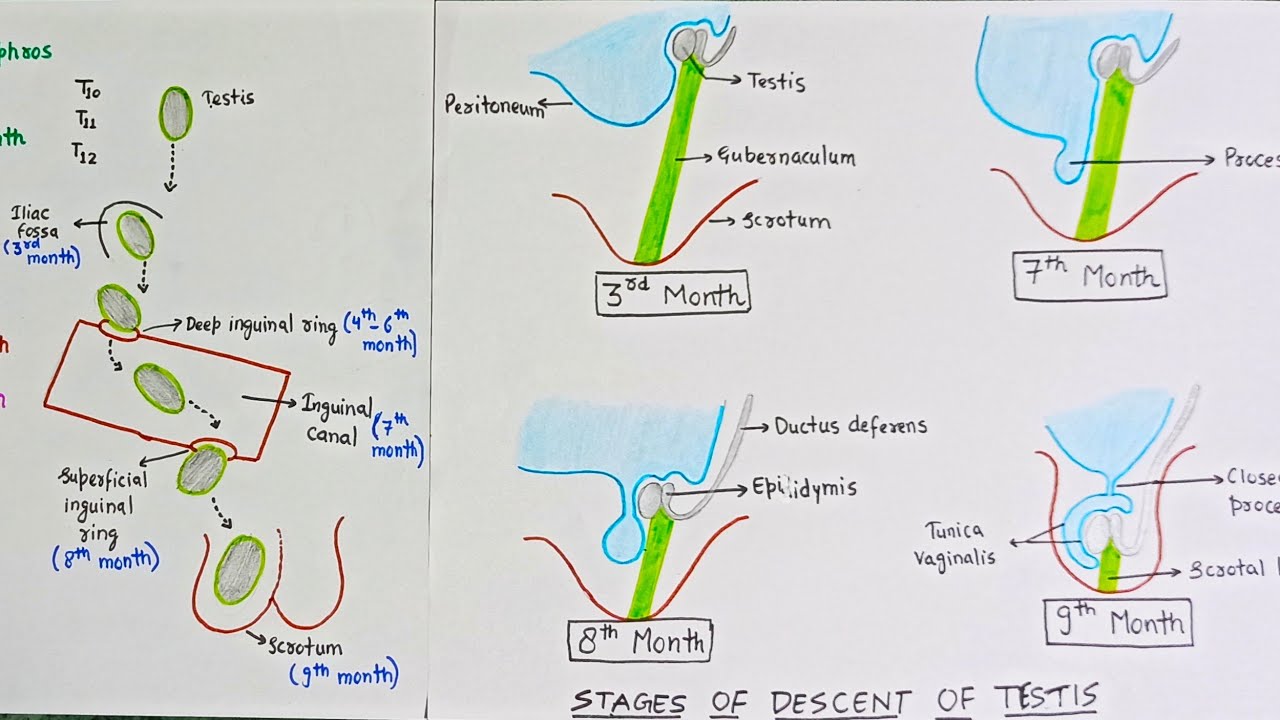
Descent of testis:

  • Testis develop on posterior abdominal wall behind peritoneum
  • A gubernacular cord extends from lower pole of testis to scrotal pouch
  • Gubernacular cord shortens due to chorionic gonadotropins and increased intraabdominal pressure
  • Goes through inguinal canal
  • Remnant of gubernaculum disappears
  • An evagination of peritoneal cavity called vaginal process enters scrotum
  • Forms serous cavity for testis called tunica vaginalis
  • Proximal part of vaginal process obliterated
descent of testis

Anomalies of testis:

  1. Cryptorchidism – undescended testis
  2. Maldescended testis – lying somewhere over the normal line of descent
  3. Ectopic testis – outside that line
  4. Congenital inguinal hernia – failure of obliteration of proximal vaginal process

Male genital ducts

1. Mesonephric tubules:

  • Upper – degenerate, form appendix of epididymis
  • Middle – 6-12 form head of epididymis and are connected to rete testis
  • Lower – degenerate, form paradidymis

2. Mesonephric duct:

  • Body and tail of epididymis
  • Vas deferens
  • Seminal vesicle
  • Ejaculatory duct

3. Mullerian duct (notes in female):

Degenerates completely except the upper end – forms appendix of testis


Ovaries

  • Primitive sex cords break into clusters of cells – form primary medullary cords
  • Which is replaced by vascular stroma to form – medulla of ovary
  • Coelomic epithelium proliferates again – forms 2nd generation of ovary (sex) cords
  • Which will divide into clusters of cells – follicular cells of primary follicle
  • Primordial germ cells incorporate into primary follicles – form oogonia
  • Primitive cortex becomes secondary cortex containing primary follicles
  • Medulla is just vascular stroma, no follicles
Image result for development of ovaries

Descent of ovaries:

  • Ovary develops in posterior abdominal wall
  • Gubernacular cord from lower pole of ovary to labia majora
  • Pulls ovary to its level on pelvis
  • Uterus develops, gubernaculum divides into 2 parts:
  1. Ovarian ligament – ovary to uterus
  2. Round ligament – uterus to labia majora (goes through inguinal canal)

Congenital anomalies of ovaries:

  1. Congenital absence – Turner’s syndrome
  2. True hermaphroditism – gonads of both sex present
  3. Imperfect descent – in inguinal canal
  4. Vagina agenesis

Female genital ducts

  • 2 mullerian (paramesonephric) ducts arise from coelomic epithelium, lateral to mesonephric ducts
  • Grow caudally, curve medially infront of mesonephric duct, meet each other and grow caudally
development of genital system - female genital ducts
  • The 2 ducts fuse to form uterovaginal canal
  • The lower tip of uterovaginal canal grows downwards and protrudes posterior wall of urogenital sinus
  • 2/3 of mullerian ducts form oviducts
  • Uterovaginal canal forms uterus and upper 4/5 vagina
  • Where the 2 ducts unite, forms fundus of uterus
  • Lower 1/5 vagina forms from definitive urogenital sinus

Union between upper 4/5 and lower 1/5 vagina is demarcated by hymen

Mesonephric tubules and mesonephric duct degenerates

Congenital anomalies:

  1. Double uterus, double vagina – complete failure of fusion
  2. Double uterus, single vagina – partial failure of fusion
  3. Agenesis of uterus – failure of both mullerian ducts to develop
  4. Rudimentary horn – failure of one mullerian ducts to develop, therefore one fallopian tube, and half body of uterus connected to rudimentary horn
  5. Atresia of cervix/vagina
  6. Imperforate hymen – cells between junction fail to degenerate
  7. Remnants of mesonephric tubules – enlarge and form cysts
  8. Remnants of mesonephric duct – Gartner’s duct
  9. Infantile uterus – small uterus, large cervix
Image result for Gartner's duct

Development of urinary system

Development of kidney, urinary bladder and urethra


Kidney

  • Intermediate mesoderm: kidneys, ureters and trigone of urinary bladder
  • Endoderm: rest of urinary bladder, urethra

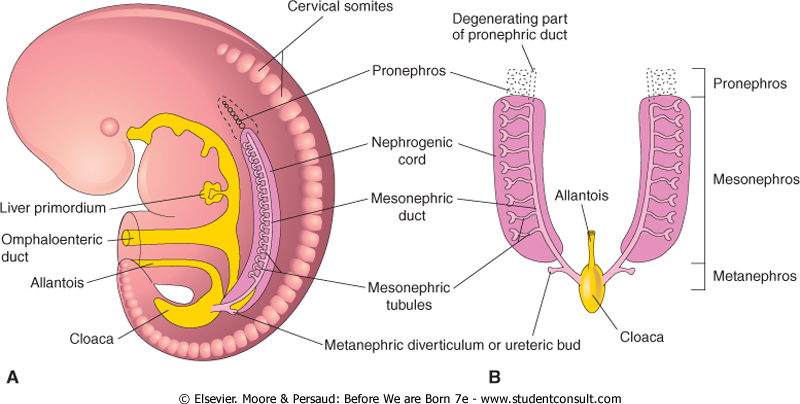
3 kidneys develop: Pronephros, mesonephros and metanephros

development of kidneys - mesonephros
Image result for pronephros, mesonephros, metanephros
development of kidney

(I) Pronephros:

  • Segmented cervical intermediate mesoderm
  • 7-10 excretory tubules called pronephric tubules form – degenarate by end of 4th week
  • Collecting duct called pronephric duct forms and opens down into cloaca – pronephric duct persists to form mesonephric duct

(II) Mesonephros:

  • Segments of thoracic and upper lumbar region of intermediate mesoderm
  • Each segment forms 2-3 ‘S’ shaped mesonephric tubules
  • Lateral ends open in mesonephric duct and medial end invaginated by glomerulus

In males:

  • Mesonephric tubules: upper degenerate, rest form efferent ducts of testis, head of epididymis, paradidymis
  • Mesonephric duct: body and tail of epididymis, vas deferens, ejaculatory duct, seminal vesicle, ureteric bud and trigone of urinary bladder

In females:

  • Mesonephric tubules: degenerate
  • Mesonephric duct: ureteric bud and trigone of urinary bladder

(III) Metanephros: (kidneys)

(A) Development of collecting duct and ureter:

  • Ureteric bud develops from mesonephric duct
  • Ureteric bud grows cranially, and penetrates metanephric cap
  • Upper end of ureteric bud enlarges ⇒ forms pelvis which divides into ⇒ 2-3 major calyces ⇒ where each divides into minor calyces ⇒ then collecting tubules ⇒ which join to nephrons 
Image result for development of urinary bladder
Image result for development of kidney

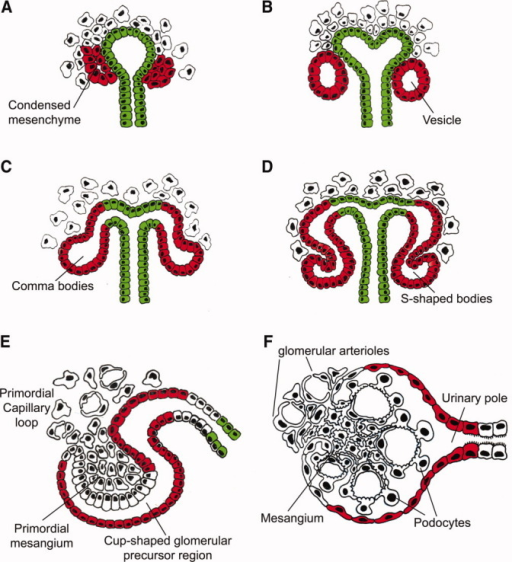
(B) Development of nephrons:

  • Caudal part of intermediate mesoderm forms a metanephric cap
  • Which divides into renal vesicles
  • Each renal vesicle surrounds the free end of a collecting tubule and forms a ‘S’ shaped nephron
  • One end of nephron invaginated by glomerulus – Bowman’s capsule
  • Other end joins collecting duct
  • Each nephron elongates – forms proximal and distal convolutes tubules and loop of Henle
Image result for renal vesicles
development of nephrons

Further growth of kidney:

  1. Lobulated grooves disappear – forms smooth surface
  2. Ascends from pelvic region to adult level
  3. Recieves blood supply from median sacral, common iliac, lower abdominal aorta. Then only from aorta
  4. At first, hilum directed forwards, rotates 90 degrees so hilum becomes medial

Congenital anomalies of kidney:

  1. Renal agenesis
  2. Renal hypogenesis – small size
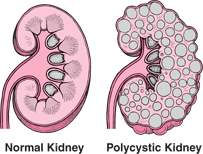
  3. Congenital polycystic kidney – failure of fusion between nephrons and collecting tubules. Urine collects in nephrons, dilates and forms cysts, nephrons destroyed
  4. Pelvic kidney – failure of ascent
  5. Horseshoe shaped kidney – fusion of both kidneys, ureters kinked, this causes urinary stasis and so infection
  6. Additional branches of aorta supplying kidney – cross infront of ureter and compress it – urinary stasis
  7. Double ureter – 2 ureteric buds/ early splitting of ureteric bud. More liable to infection and stone formation
Image result for Congenital polycystic kidney

Urinary bladder and urethra

A constriction appears in primitive urogenital sinus at site of entrance of mesonephric duct

Divides into:

  1. Upper part – Vesico-urethral canal
  2. Lower part – Definitive urogenital sinus

(I) In males

(A) Urinary bladder:

  • From vesico-urethral canal
  • Trigone from absorbed common stem of mesonephric duct and ureter. 

Differential growth of posterior bladder wall, therefore ureter moves upwards (posterior superior angle)

(B) Seminal vesicle:

Develops as a diverticulum from vas deferens. Part distal to it becomes ejaculatory duct.

(C) Urethra:

1. Prostatic urethra:

  • Upper 1/2 – vesicourethral canal
  • Lower 1/2 – Definitive urogenital sinus

2. Membranous urethra – Definitive urogenital sinus

3. Penile urethra – Definitive urogenital sinus forms a urethral plate that extends on the under surface of phallus (primitive penis) and is surrounded by 2 urethral folds – unite from back and front around urethral plate to form penile urethra. Lined by endoderm, terminal glandular part lined by ectoderm.

(D) Prostate gland:

  • Develops from 15 to 20 buds from prostatic urethra
  • Canalized to form alveoli and ducts
  • Connective tissue and capsule from surrounding mesoderm

(II) In females

  1. Vesicourethral canal – urinary bladder and urethra
  2. Definitive urogenital sinus – lower 1/5 vagina and vestibule

Congenital anomalies:

  1. Urachal fistula – unobliterated urachus. Urine drips from umbilicus
  2. Urachal cyst – Incomplete obliteration
  3. Bladder extrophy – urinary bladder opens into anterior abdominal wall
  4. Hypospadius – external urethral meatus opens on under surface of penis
  5. Epispadius –  external urethral meatus opens on upper surface of penis

Development of midgut and hindgut

Midgut

Origin: Endodermal

development of midgut and hindgut
  1. Cranial limb – forms jejunum and ileum
  2. Caudal limb – forms ascending colon and 2/3 of transverse colon
  3. Cecal swelling – forms cecum, appendix and part of ascending colon
  • Intestinal loop elongates rapidly and leaves the small abdominal cavity and enters umbilical cord – physiological umbilical hernia (6th to 10th week)
  • The elongating loop rotates 270 degrees anticlockwise around axis of superior mesenteric artery (seen in the diagram)
  • Therefore upper part of small intestine lies behind colon
  • 10th week, abdominal cavity enlarges and :
  1. Jejunum reenters to left side
  2. Ileum reenters to right side
  3. Cecal swelling reenters below liver
  • Cecal swelling elongates downwards to right iliac fossa – forms right colic flexure and ascending colon
  • Vitellointestinal duct obliterated

Congenital anomalies:

  1. Remnant of vitelline duct:
  • Meckel’s diverticulum – proximal part near ileum remains patent
  • Vitelline fistula – whole vitelline duct remains open
  • Vitelline cyst – Middle part remains open
Image result for vitelline cyst

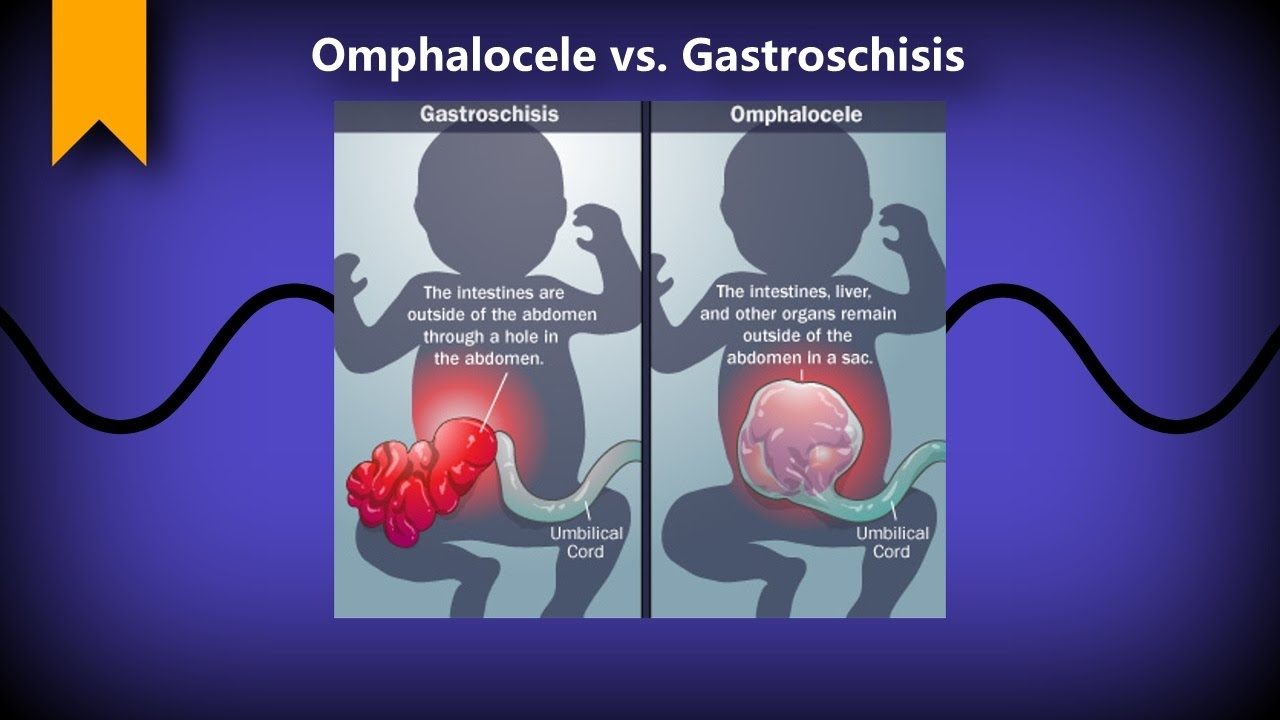
2. Omphalocele/ Congenital umbilical hernia – Failure of reduction of physiological hernia due to defect in abdominal wall muscles development

3. Gastroschisis

Image result for omphalocele vs gastroschisis

4. Atresia/ stenosis of any part of primitive intestinal loop – bowel obstruction

5. Abdominal rotation of intestinal loop  – 90 degrees only or clockwise rotation


Hindgut

Origin: Endodermal

Derivatives: Left 1/3 transverse colon, descending colon, sigmoid colon, rectum, upper 1/2 anal canal (Lower 1/2 anal canal, proctodeum – ectodermal)

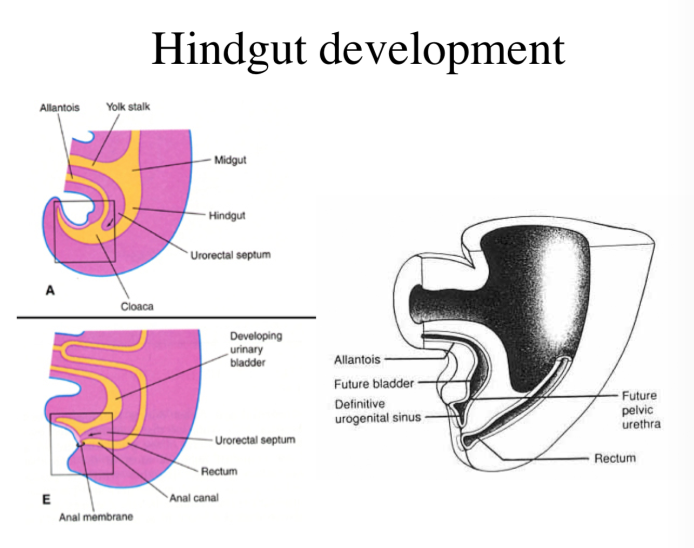
  • Lower end of hindgut dilates to form cloaca
  • And then continues as allantois to umbilicus
  • Below cloaca is cloacal membrane
  • Which is bilaminar: outer ectoderm, inner endoderm
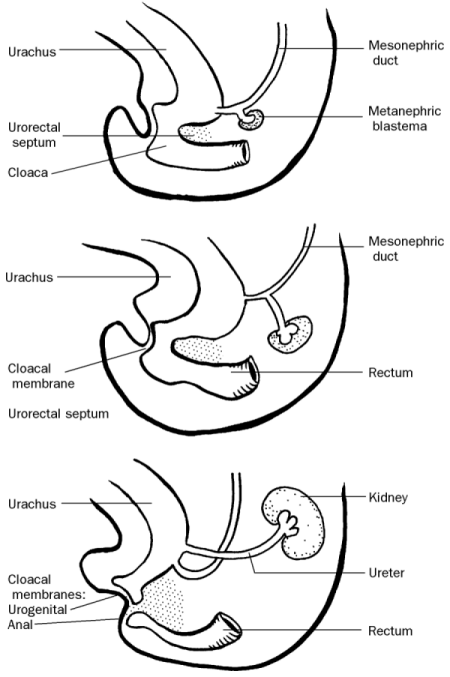
  • Between hindgut and allantois is a urorectal septum, which grows caudally and divides the cloaca and cloacal membrane  into:
  1. Primitive urogenital sinus (ventrally) – Urogenital membrane
  2. Rectoanal canal (dorsally) – anal membrane
  • Opposite rectoanal canal, ectodermal depression called proctodeum forms
  • Anal membrane ruptures:
  1. Proctodeum – lower 1/2 anal canal
  2. Rectoanal canal – rectum and upper 1/2 anal canal
development of hindgut
Hindgut development

Congenital anomalies:

  1. Imperforate anus – anal membrane fails to rupture
  2. Atresia of rectum – Proctodeum fails to develop
  3. Stenosis of rectum – incomplete canalization
  4. Recto – vaginal fistula, recto – urinary fistula, recto – urethral fistula – incomplete division of cloaca
  5. Anal atresia, anal stenosis
  6. Ectopic anus

Development of septum transversum and diaphragm

Septum transversum

It is a thick mass of mesoderm which partially separates thoracic cavity and abdominal cavity.

  • Forms in neck by fusion of 3, 4, 5 cervical myotomes
  • Motor nerve is phrenic nerve
  • Embryonic disc folds and heart descends, therefore septum transversum is pushed caudally and pulls the phrenic nerve with it

Derivatives:

  1. Superior layer – formation of fibrous pericardium
  2. middle layer – diaphragm muscle, central tendon, diaphragmatic pleura and peritoneum
  3. Inferior layer – fibrous capsule and connective tissue of liver, ventral mesentery of the gut


Diaphragm

Origin: Mesoderm

Diaphragm develops from:

  1. Septum transversum – Central tendon, sternal and costal parts of diaphragm
  2. 2 pleuro-peritoneal membranes – 2 mesodermal folds that project inwards from body wall. Close pleuro-peritoneal canals. Forms dorsilateral part of diaphragm
  3. Mesoderm from chest wall – marginal part of diaphragm
  4. Mesentery of esophagus – Posterior medial part and crura of diaphragm
  5. Mesoderm around aorta – lumbar part of diaphragm


Image result for development of diaphragm

Congenital anomalies:

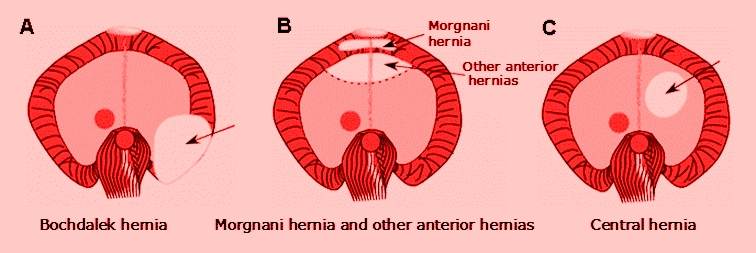
  1. Parasternal hernia of Morgagni – failure to develop a small part of diaphragm between sternal and costal part
  2. Esophageal hernia – Protrusion of stomach in thorax
  3. Congenital diaphragmatic hernia of Bochdalek – failure of pleuro-peritoneal membranes to close the pleuro-peritoneal canals. Abdominal vicera enter pleural cavity, compress heart and lungs

Image result for Parasternal hernia of Morgagni

Development of pituitary gland and SNS

Development of pituitary gland and sympathetic nervous system

Pituitary gland

Anterior lobe (adenohypophysis)

  • Ectoderm – roof of stomodeum 
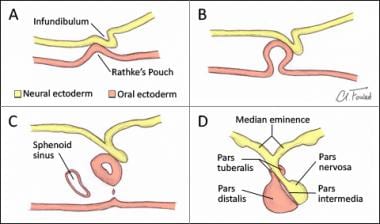
  • Forms diverticulum called Rathke’s pouch, which grows upwards from stomodeum infront of buccopharyngeal membrane
  • End of 3rd month, loses connection with stomodeum and differentiates into; Pars distalis, Pars tuberalis and Pars intermedia
  • Lumen gets obliterated

Posterior lobe (neurohypophysis)

  • Neural ectoderm – floor of diencephalon
  • Forms diverticulum called Infundibulum, which grows downwards
  • Differentiates into; Pars nervosa and pituitary stalk

Development of pituitary gland

Congenital anomalies:

  1. Agenesis
  2. Absence of anterior lobe – failure of developing Rathke’s pouch. Leads to maldeveloped thyroid gland, suprarenal gland and testes
  3. Pharyngeal hypophysis – remnant of Rathke’s pouch remains attatched to pharyngeal wall

Sympathetic nervous system

  • Neural crest cells in thoracic region
  • Migrate to each side of the spinal cord, behind dorsal aorta
  • Form a bilateral chain of segmentally arranged sympathetic ganglia which are connected by longitudinal nerve fibers
  • Neuroblasts migrate from thorax region to cervical and lumbosacral regions, therefore extending the sympathetic chains

In cervical region, ganglia fuse to form superior, middle and inferior cervical ganglia

Some neuroblasts migrate infront of aorta to form celiac, superior mesenteric and inferior mesenteric ganglia

Some neuroblasts migrate to heart, lungs or GIT to form sympathetic organ plexuses

Some migrate to form medulla of suprarenal glands

Development of spleen and suprarenal glands

Spleen

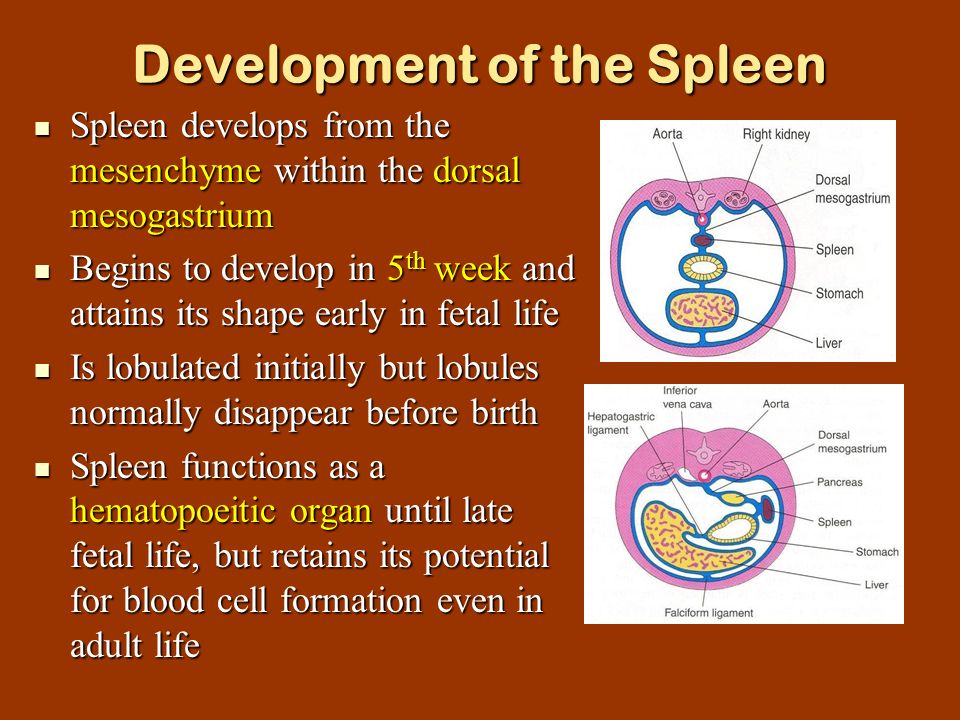
Origin: Mesodermal cells in dorsal mesogastrium

  • These cells will form stroma and capsule
  • Hematopoietic cells infiltrate spleen
  • Dorsal mesogastrium forms: gastrosplenic ligament and splenorenal ligament

NB: Hematopoietic function lost with embryo development. Lymphoid precursor cells migrate into developing organ

development of spleen

Congenital anomalies:

  1. Accessory spleen
  2. Wandering spleen – lacks one ligament or both
  3. Polysplenia/ Chaudhrey’s disease – multiple small accessory spleens

Suprarenal glands

  • Cortex – Mesodermal cells of intraembryonic coelomic epithelium
  • On either side of mesentery of gut, proliferates to form fetal cortex
  • Medulla – Sympatho – chromaffin cells from neural crest cells (ectoderm)
  • Migrate to enter medial aspect of fetal cortex
  • Second layer of cells develop from coelomic mesothelium and surrounds fetal cortex to form permanent cortex
  • Fetal cortex regresses and disappears after 3rd year of birth
  • Permanent cortex differentiates into 3 zones: zona glomerulosa, zona fasiculata and zona reticularis. Complete histological differentiation attained at puberty.
Image result for development of suprarenal gland

Congenital anomalies:

  1. Agenesis
  2. Ectopic suprarenal gland – below capsule of kidney
  3. Accessory cortical tissue – found on posterior abdominal wall and pelvis
  4. Adrenogenital syndrome – hypertrophy of suprarenal cortex and over production of androgens. Results of pseudohermaphroditism in females and premature enlargement of external genitalia in males

Development of liver and gall bladder

Origin: Endoderm of foregut

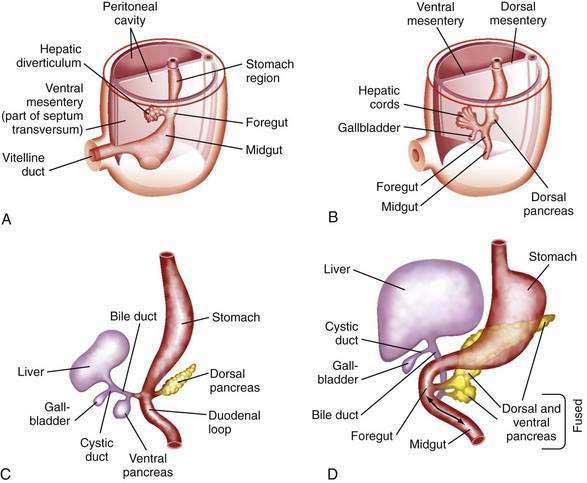
  • Liver bud develops from lower end of foregut
  • Liver bud divides into two parts:
  1. Smaller part: Pars cystica ⇒ forms gall bladder
  2. Large cranial part: Pars hepatica
  • Pars hepatica invades septum transversum and divides into right and left branches (right and left hepatic ducts) which branch more to form columns of hepatic cells
  • Columns of hepatic cells meet vitelline veins and break them into hepatic sinusoids
  • Mesoderm of septum transversum forms fibrous tissue stroma and capsule of liver
  • Original stalk of liver bud elongates – forms common bile duct
  • Due to rotation of stomach, common bile duct opens in posterior medial part of 2nd duodenum

Ligaments of liver:

  • Mesoderm of septum transversum between liver and anterior abdominal wall forms falciform ligament. Umbilical vein lies on inferior free margin of falciform ligament
  • Mesoderm of septum transversum between liver and stomach forms lesser omentum

Liver separates from septum transversum except “bare area” of liver

Rest of septum transversum forms part of diaphragm

Image result for Development of liver and gall bladder

Congenital anomalies:

  1. Atresia of common bile duct
  2. Partial or complete duplication of gall bladder
  3. Congenital absence of portal vein
  4. Accessory hepatic duct