Category Archives: Oral Pathology

Non odontogenic sarcomas

Liposarcoma

Origin: Adipocytes, rare in head and neck

Clinical: Slow growing mass

Subtypes:

  • Well differentiated
  • Myxoid
  • Round cell
  • Pleomorphic

Management:

  • Surgical excision with radiation
  • Good prognosis

Picture


Leiomyosarcoma

Origin: Spindle shaped smooth muscle cells

Resembles fibrosarcoma clinicopathologically, therefore to differentiate in diagnosis

Diagnosis: +ve desmin and +ve actin

Picture


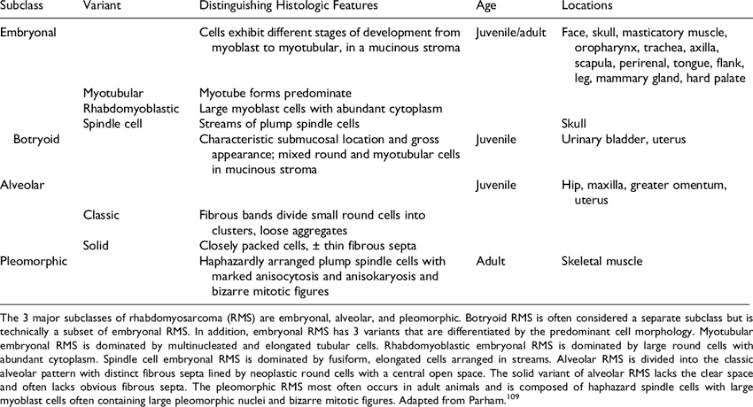
Rhabdomyosarcoma

Origin: Striated muscle

Clinical presentation: Overlying skin is shiny, red, warm, can feel thrill/bruit

Diagnosis: +ve desmin and +ve actin

Management: Surgery, chemotherapy, radiotherapy

Histology:

2 Histological forms:

1. Embryonal:

  • In head and neck and GUT
  • 4-6 year olds
  • Primitive round cells:
    • Spindle
    • Grape like – botryoid

2. Alveolar:

  • Extremities/trunk
  • > 10 year olds

Picture


Neurofibrosarcoma

Origin: Schwann cells, neural cells

Clinical: Mass causing pain and paresthesia

Histology: Plump spindle cell – arranged in streaming pattern

Diagnosis: If resembles fibrosarcoma, confirm with S-100 staining

Management: Surgery and radiation

Picture

Chondrosarcoma

Formation of cartilage by tumor cells

Site: < 1% in head and neck

Clinical:

  • Painless/ painful swelling
  • Loosening of teeth

Histology:

  • Cartilage showing varying degree of maturation
  • Cartilage tissue with pleomorphic, binucleated chondrocytes + mitosis

Grade I:

  • Chondroid matrix + chondroblasts
  • Mimics a chondroma
  • Rarely mitosis

Grade II:

  • More myxoid matrix
  • Pleomorphism with moderate nuclei
  • Low mitotic rate

Grade III:

  • Rare
  • Highly cellular
  • Spindle cell proliferation
  • Prominent mitosis

Management:

  • Radical surgical excision
  • Locally aggressive + metastasis (lung)

Picture

Osteosarcoma

Most common primary malignancy of bone

Risk factors:

Clinical:

  • Asymmetrical jaw swelling
  • Painful firm swelling
  • Loosening of teeth
  • Parasthesia
  • Nasal obstruction
  • Rapid local growth – early metastasis (lungs)

Radiology:

  • Poorly defined margin – Sunburst appearance
  • Radiolucent
  • Dense sclerosis/mixed sclerosis
  • Widening PDL space
  • Moth eaten appearance

Histology:

  • Malignant mesenchymal cells – produce osteoid
  • Cells are spindle shaped – pleomorphic with bizarre nuclear and cytoplasmic shapes
  • Osteoid formation + atypical osteoblasts + cartilage + fibrous tissue
  • Abnormal mitosis

Subtypes: Depending on amount of osteoid, collagen and cartilage

  • Osteoblastic
  • Chondroblastic
  • Fibroblastic

Management:

  • Radical excision surgery + radiotherapy
  • Poor prognosis: 30-50% survival rate
  • 50% recurring in 1st year

Picture

Fibrosarcoma

Origin: Spindle cell tumor

Clinical: Locally destructive lesion – causing 2ry ulceration

Histology:

  • Herring bone or interlacing fascicular pattern
  • Sparse collagen matrix, contains fibroblasts

Diagnosis:

  • MRI
  • Exclusion of actin, S-100, epithelial antigens, keratin and desmin

Management: Wide excision

Picture

Salivary gland neoplasms

Mucoepidermoid carcinoma

Most common salivary gland malignancy

Origin: Interlobular and intralobular tissue of salivary duct system

Site: Parotid gland and palate

Clinical: Pain and ulceration

Histology:

  • Large pale mucous secreting cells surrounded by epidermoid (squamous) cells

Low grade tumor:

  • Well differentiated cells
  • > 50% mucus cells
  • Cystic
  • Good prognosis

High grade tumor:

  • Poorly differentiated cells
  • < 10% mucus cells
  • Solid
  • Poor prognosis

Management:

  • Wide excision
  • Can recur

Picture


Polymorphous low grade adenocarcinoma

Origin: Proximal salivary duct cells

Site: Minor glands in palate

Clinical: Asymptomatic submucosal mass

Histology:

  • Homogenous appearance of cells + vesicular nuclei + scanty cytoplasm
  • Arranged in solid, streaming or pseudo cribriform patterns

Management: Conservative excision

Picture


Adenoid cystic carcinoma

High grade malignancy

Site: Minor salivary glands

Clinical:

  • Pain and ulceration
  • Perineural invasion – paralysis
  • Distant metastasis to lungs

Histology:

  • Neoplastic epithelium in ovoid/irregularly arranged islands
  • Numerous microcytic spaces within islands – “Swiss cheese” or “cribriform” pattern
  • Solid/tubular pattern – poor prognosis

Management:

  • Complete excision
  • Chemotherapy, radiotherapy
  • Nerve grafting
  • Can recur

Picture


Clear cell carcinoma

Low grade tumor affecting minor glands

Site: Palate

Clinical: Submucosal mass

Histology: Clear cell change due to – cytoplasmic accumulation of glycogen and microfilaments

Picture


Acinic cell carcinoma

Origin: Duct reserve cells + acinic cells

Site: Parotid gland

Clinical: Mimics adenoma

Histology:

  • Blue dot tumor
  • Sheets/acini of large polyhedral cells + basophilic granular cytoplasm

Management:

  • Aggressive excision
  • Poor prognosis for poorly differentiated

Picture


Unspecific adenocarcinoma

Site: Salivary epithelium

  • Non specific features, a diagnosis of elimination

CA in PSA

Origin: Untreated long standing pleomorphic adenoma. Malignant mixed tumor

Site: 68% from parotid

Histology: Neoplastic change in mixed tissues

Management:

  • Aggressive surgical resection
  • Poor prognosis

Malignant non odontogenic tumors

Non odontogenic carcinoma (epithelial)

  1. Oral squamous cell carcinoma
  2. Verrucous carcinoma
  3. Salivary gland carcinoma
    • Mucoepidermoid carcinoma
    • Polymorphous low grade adenocarcinoma
    • Adenoid cystic carcinoma
    • Clear cell carcinoma
    • Acinic ell carcinoma
    • Unspecific adenocarcinoma
    • CA in PSA

Non odontogenic sarcoma (mesenchymal)

  1. Fibrosarcoma
  2. Angiosarcoma – Kaposi’s sarcoma
  3. Osteosarcoma
  4. Chondrosarcoma
  5. Liposarcoma
  6. Leiomyosarcoma
  7. Rhabdomyosarcoma
  8. Neurofibrosarcoma
  9. Lymphoma:

Leukemia

  • Neoplastic proliferation of white blood cells
  • Replacement of bone marrow
  • Infiltrate organs (spleen and liver)
  • ALL – Most common in children
  • AML – Most common in adults

Clinical:

  • Splenomegaly and hepatomegaly
  • Lymphadenopathy
  • Mucosal pallor and abnormal gingival bleeding in a child
  • Pancytopenia and it’s effects
  • Cancer symptoms

Oral effects of acute leukemia:

  • Gingival swelling
  • Mucosal ulceration
  • Leukemic deposits
  • Purpura
  • Anaemia
  • Cervical lymphadenopathy

Diagnosis:

  • Bone marrow biopsy
  • Peripheral blood film

Dental management of patient with leukemia:

  • Extraction should be avoided
  • If necessary: Blood grouping, cross matching, blood transfusion and generous antibiotic cover is needed
  • Antimicrobial mouth rinses
  • Routine dental treatment

Picture

Cementoblastoma

Etiology

  • Rare benign lesion of cementoblastic origin

Clinical

  • Low grade intermittent pain
  • Lesion surrounded by periodontal ligament space – cortical expansion

Site

  • Mandible > Maxilla
  • Posterior > Anterior
  • Close association with root of vital tooth

Radiology

  • Radiopaque, obliterating root of a tooth
  • Surrounded by lucent halo

Histology

  • Dense mass of cementum like material with reversal lines
  • Large hyperchromatic cementoblasts and cementoclasts depending on remodeling going on

Management

  • Bone relief by sacrifice of associated tooth
  • No recurrence

Picture

Odontogenic myxoma

Etiology

  • Origin from dental papilla/follicular mesenchyme

Clinical

  • Rarely pain
  • Slow growing
  • Aggressively invasive
  • Sometimes associated with impacted teeth
  • Expansile lesion
  • Outer cortical plate expansion – leads to perforation
  • If occurs in maxilla, invades maxillary sinus – exophthalmos

Radiology

  • Early: Unilocular
  • Multilocular radiolucency with septae in a “tennis racket” or “honey comb” appearance
  • Poorly defined boundaries

Histology

  • Stellate cells with long process – forms loose meshwork – interspersed with mucoid intercellular CT – which has occasional strands of odontogenic epithelium

Management

  • Aggressive surgical excision – with safe margin of 1.5-2cm
  • Reconstruction
  • Good prognosis – does not metastasize

Picture

Odontoma

Common hamartomas of odontogenic epithelium and mesenchyme that contain dental hard tissues

Subtypes

1. Simple odontoma

Picture

2. Compound odontoma

  • Appear as numerous rudimentary teeth
  • Common site: Anterior jaw, maxilla
  • Dental tissues: enamel, dentine, cementum
  • Present as lobulated appearance, with no definitive demarcations of separate tissues between individual “toothlets” or denticles

Picture

3. Complex odontoma

  • Amorphous conglomerations of hard tissues
  • Incidental findings in mandibular molar area in female patients
  • Site: Mandible > maxilla, posteriorly
  • Radiopaque area with varying densities

Picture

Management

  • Surgical excision
  • Simple enucleation
  • No recurrence

NB:

  • Almost always associated with a missing tooth/may develop from a supernumerary tooth germ
  • May obstruct eruptions of neighboring teeth/may erupt into the mouth – infection, abscess formation
  • May be associated with pathological conditions eg. Dentigerous cyst and displace teeth