Category Archives: Embryology

Fetal circulation and changes after birth

  • Oxygenated blood
  • Placenta
  • Umbilical vein
  • Through liver
  • Ductus venosus
  • IVC  ⇐ Deoxygenated blood from lower limb
  • Right atrium
  • Foramen ovale (opening of IVC faces foramen ovale)
  • Left atrium
  • Left ventricle
  • Aorta which distributes blood


  • Deoxygenated blood
  • SVC
  • Right atrium
  • Right ventricle (septum secondum prevents from entering foramen ovale)
  • Pulmonary trunk
  • Ductus arteriosus
  • Arch of aorta
  • Mix with oxygenated blood
  • Common iliac artery  ⇒ External iliac artery (oxygenated blood to lower limbs)
  • Internal iliac artery
  • 2 Umbilical arteries
  • Placenta


Mixing of oxygenated and deoxygenated blood in fetus:

  • Liver – Umbilical vein (oxy) + Portal vein (deoxy)
  • IVC – Ductus venosus(oxy) + Blood from lower limb (deoxy)
  • Left atrium – Right atrium (oxy) + lung buds (deoxy)
  • Dorsal aorta – via ductus arteriosus


Changes in circulation after birth

Immediate:

  1. Pulmonary circulation starts – lungs expand, negative pressure, air suctioned
  2. Closure of foramen ovale – Pressure increases in left atrium due to pulmonary circulation, therefore septum primum and septum secondum pushed together
  3. Closure of ductus arteriosus to form ligamentum arteriosum. From pulmonary trunk to arch of aorta

Late:

  1. Ductus venosus forms ligamentum venosum of liver. From left portal vein to IVC
  2. Umbilical vein – ligamentum teres of liver. From umbilicus to left portal vein
  3. Umbilical artery – Lateral umbilical ligament. From superior vesical artery to urinary bladder.


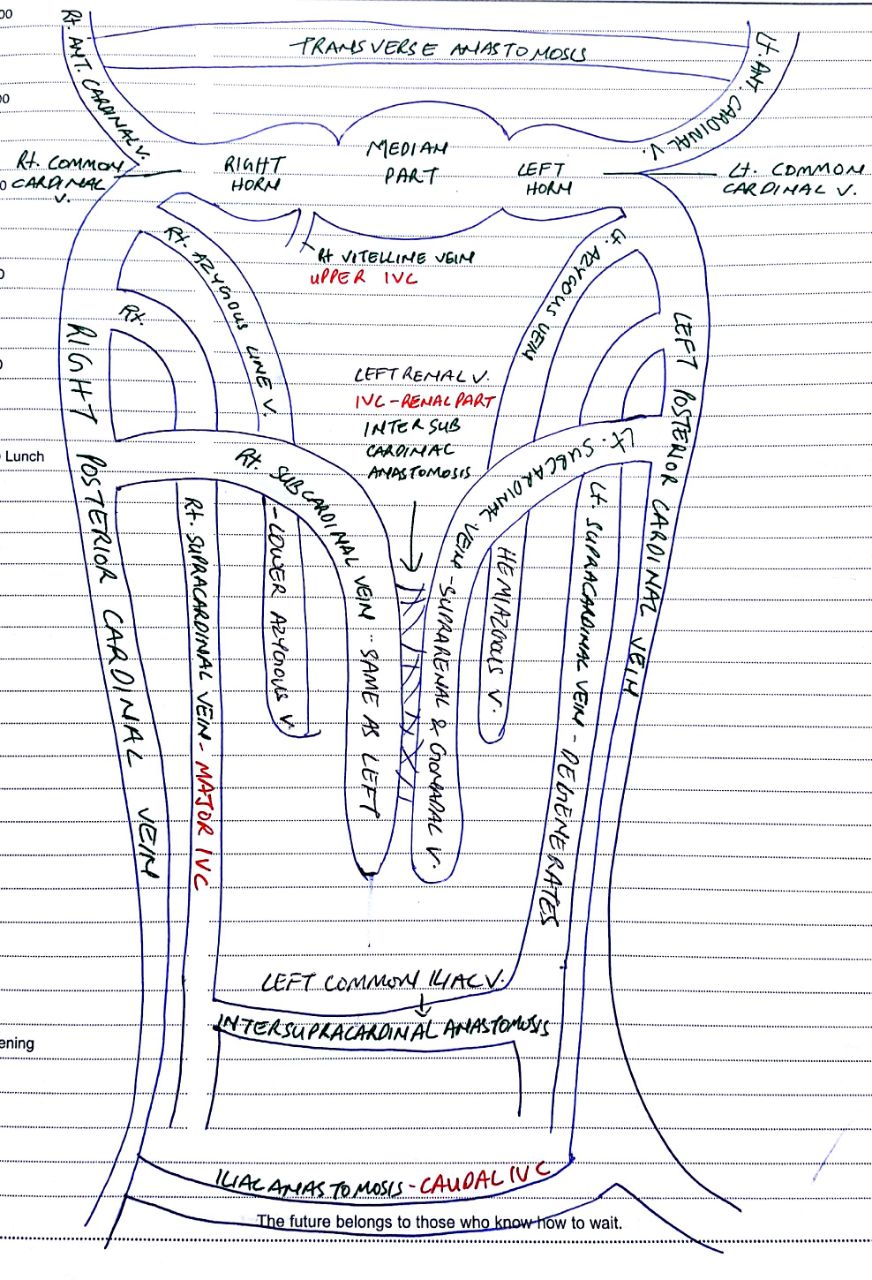
Development of veins

Refer to sinus venosus in development of heart:

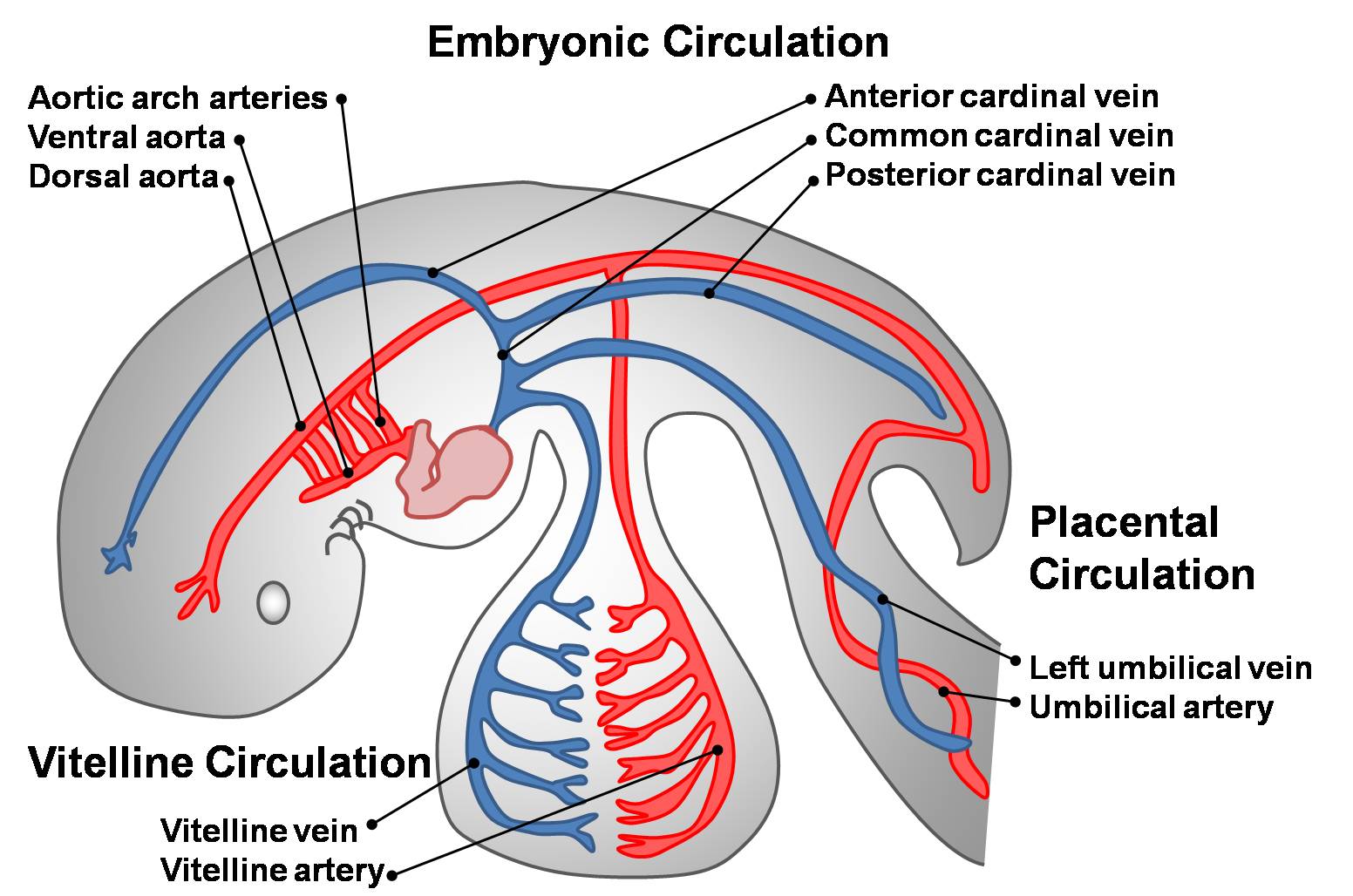
  1. Vitelline veins – drain blood from yolk sac, enter via yolk sac stalk
  2. Umbilical vein – oxygenated blood from placenta, divides into right and left branch and enters via umbilical cord
  3. Cardinal veins – body of embryo:
  • Anterior cardinal veins – drain head and neck and upper limbs
  • Posterior cardinal veins – drain lower limbs
  • Common cardinal vein – branches into anterior and posterior cardinal veins
  • Subcardinal veins – anastomose infront of aorta
  • Supracardinal veins – dorsilateral to aorta
  • Azygous cardinal veins – dorsilateral to aorta
development of veins

Development of Inferior Vena Cava:

  • Right vitelline vein
  • Intersubcardinal anastomosis
  • Right supracardinal vein
  • Iliac anastomosis

Anomalies of IVC:

  • Forms on left side instead of right due to persistent left veins mentioned above
  • Double IVC – persistence of both
  • Absent IVC – Lower body drained by azygous vein

Development of renal veins:

Right – Right metanephric vein

Left – Left metanephric vein and intersubcardinal anastomosis (since its longer than right)

Development of arteries

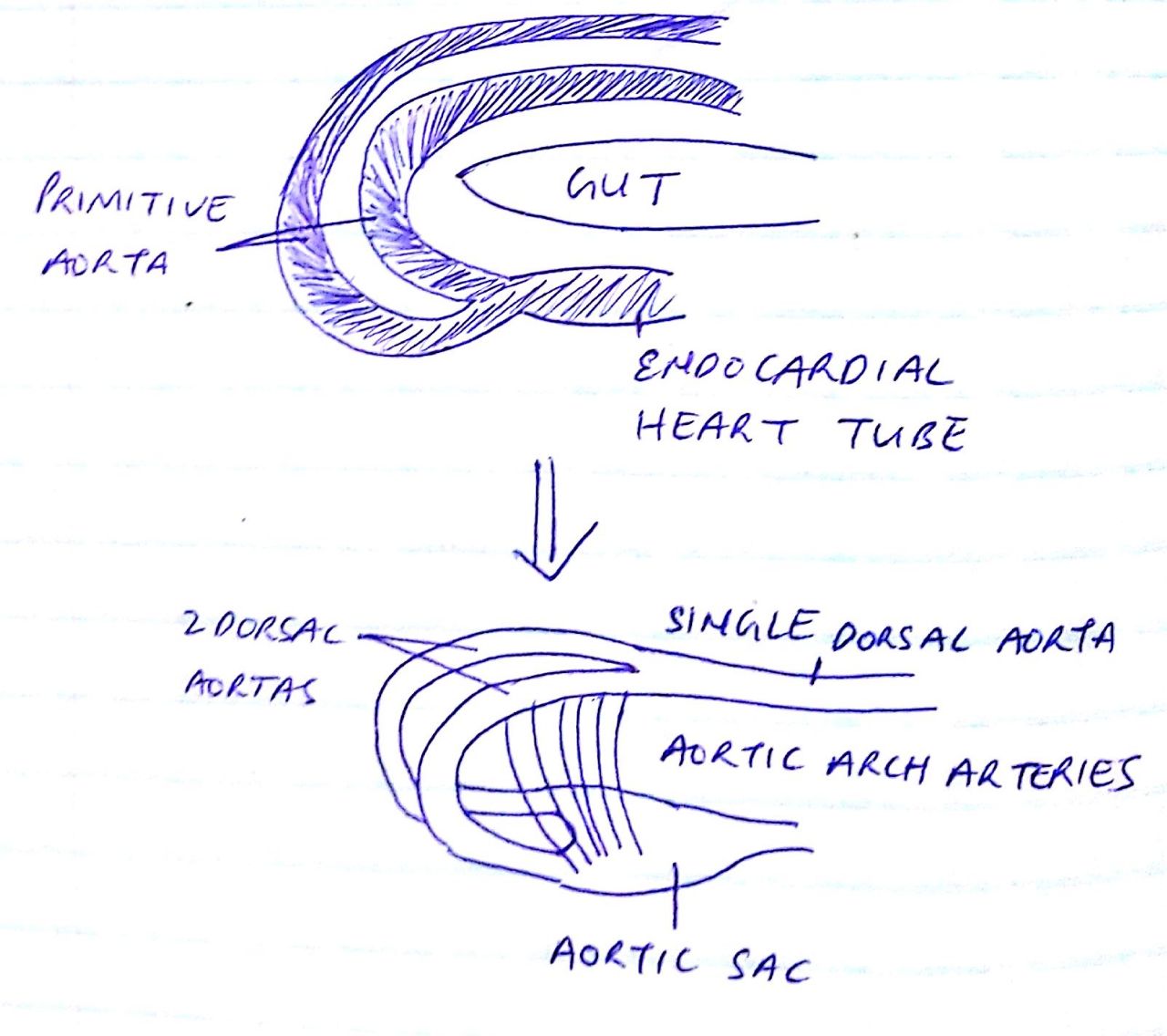
Source: Angiogenetic cells (mesodermal)

Continuation of the 2 endocardial heart tubes to form right and left primitive aorta

  • Which curve dorsally and continue as 2 dorsal aortas (dorsal to gut). Cranially are separate, caudally fuse to form a single dorsal aorta
  • And ventral to pharynx fuse – Aortic sac

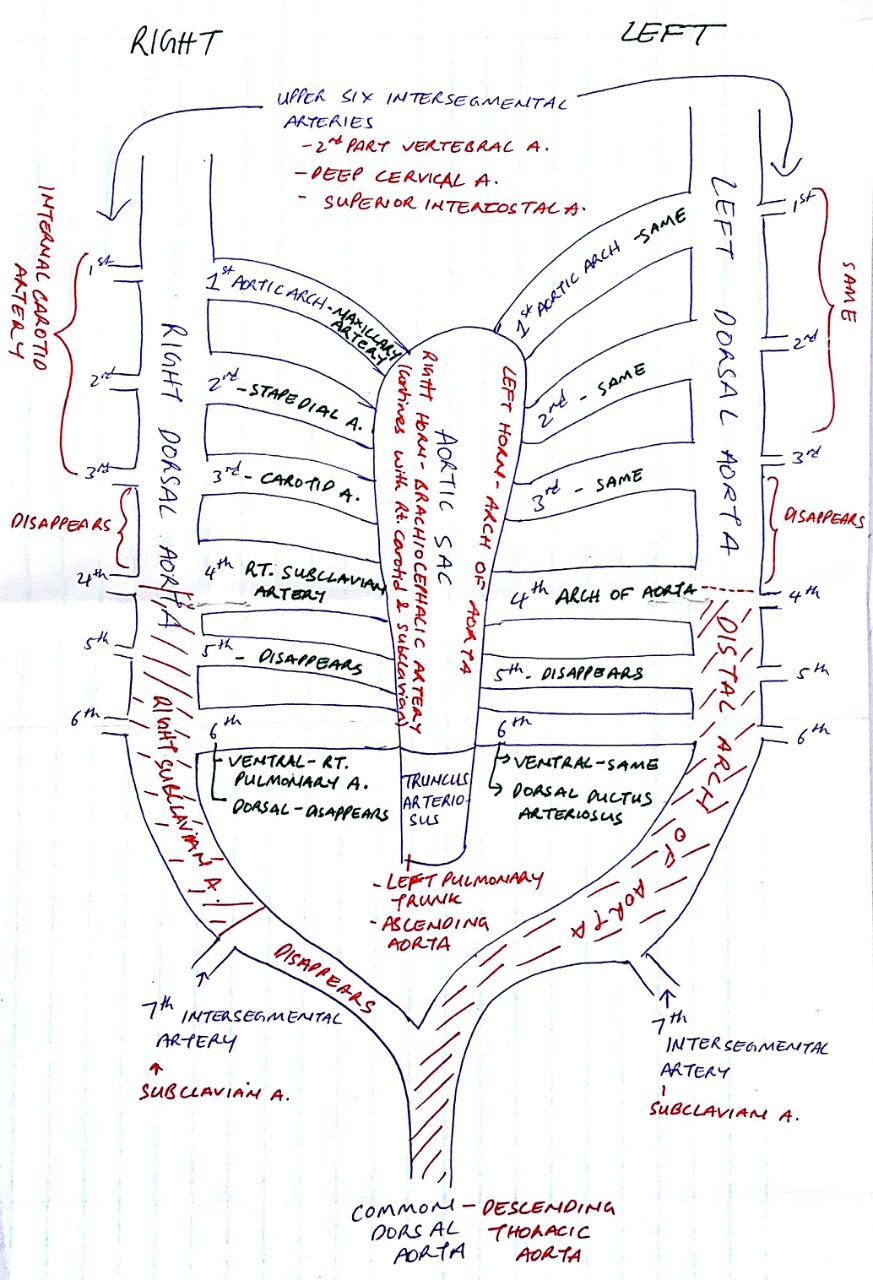
The 2 dorsal aortas connect with the aortic sac via aortic arch arteries

These are 6 pairs of arteries that run in the 6 pharyngeal arches

Development of arteries
Development of arteries embryology
embryonic circulation
development of arteries embryology
embryonic circulation

Development of arch of aorta:

  • Proximal – Aortic sac stem
  • Middle – Aortic sac left horn
  • Distal – Left 4th aortic arch, lower left dorsal aorta

Recurrent laryngeal nerve:

  • Right and left vagi descend lateral to pharynx
  • Give recurrent laryngeal nerve
  • On right side, 5th and 6th arch disappear (6th arch dorsal branch), therefore hooks around 4th aortic arch ie. subclavian artery
  • On left side, hooks around dorsal branch of 6th aortic arch ie. ductus arteriosus

Anomalies of aortic arch:

  1. Patent ductus arteriosus – failure to close, hypertrophy of left side of heart
  2. Congenital narrowing of aorta – Preductal type (above ductus arteriosus which closes) and Postductal type (below ductus arteriosus which remains open)
  3. Right sided aortic arch – Distal part of left dorsal aorta degenerates, distal part of right dorsal aorta persists
  4. Double aortic arch – both persist, leads to dysphagia (difficulty in swallowing) and dyspnea (difficulty in breathing)
  5. Abnormal right subclavian artery – 4th aortic arch degenerates, therefore arises from right 7th intersegmental artery and descending aorta

Common dorsal aorta branches:

1. Ventral:

  • Coelic artery – foregut
  • Superior mesenteric artery – midgut
  • Inferior mesenteric artery – hindgut

2. Lateral (paired):

  • Middle suprarenal artery
  • Renal artery
  • Gonadal artery

3. Posterolateral (paired):

  • Posterior intercostal arteries
  • Subcostal arteries
  • Lumbar arteries

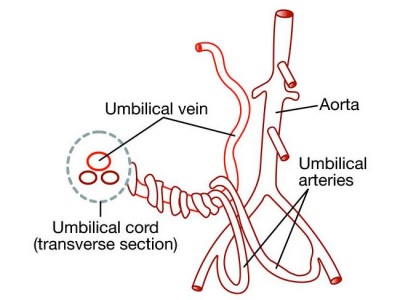
Umbilical artery:

  1. Arises from dorsal aorta
  2. Connected to 5th lumbar intersegmental artery
  3. Looses connection to dorsal aorta
  4. 5th lumbar intersegmental artery gives a branch ie. External iliac artery
  5. Continues as internal iliac artery
Umbilical artery embryology

Development of arteries in lower limb:

Continuation of external iliac arteryFemoral artery ⇒ descends infront of thigh ⇒ curves to join sciatic artery backwards to form Poplitial artery

Continuation of Internal iliac artery ⇒ Called sciatic artery ⇒ descends in back of lower limb ⇒ to sole of foot ⇒ degenerates to form Inferior gluteal artery, peroneal artery ETC

EIA and IIA anastomose to form anterior and posterior tibial arteries

Image result for development of umbilical artery

Development of arteries in upper limb:

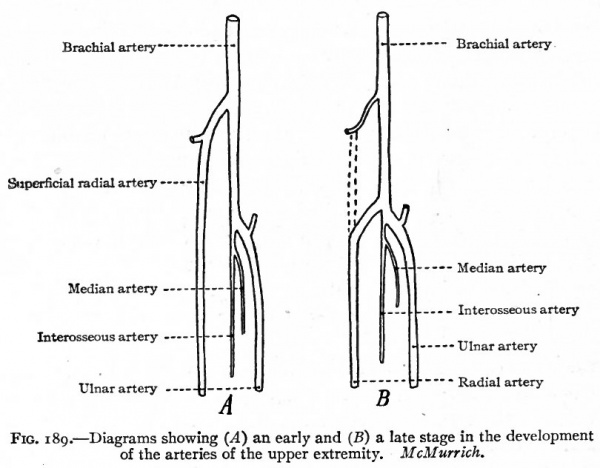
7th cervical intersegmental artery ⇒ Subclavian a. ⇒ Axillary a. ⇒ Brachial a. ⇒ Ulnar and Radial a. ⇒ give superficial and deep palmer arches

NB: Brachial a. also gives another branch called anterior interosseous artery. Anterior interosseous artery is replaced by median artery which is replaced by ulnar artery

Image result for development of arteries in upper limb

Development of heart

Origin: Splanchnic mesoderm (of lateral plate mesoderm) infront of buccopharyngeal membrane

External:

  • Angiogenetic cells (mesodermal)
  • Form 2 endocardial heart tubes
  • Fuse to form single heart tube ⇒ endocardium of heart
  • Splanchnic mesoderm, surrounding endocardium of heart, forms myocardium and epicardium
  • Intraembryonic coelom forms pericardial cavity
  • 3 constrictions appear in the heart tube, dividing it into 4 dilations:
  1. Bulbus cordis ( and truncus arteriosus)
  2. Primitive ventricle
  3. Primitive atrium
  4. Sinus venosus (and right and left horns receiving veins)
  • The heart tube grows faster than pericardium
  • Forms U shape, then S shape heart tube

Internal:

1. Sinus venosus

Opens in primitive atrium by sinoarterial orifice guarded by right and left valves

Derivatives of all parts of the sinus venosus are shown below in red

Sinus venosus
sinoarterial orifice

2. Atria 

Development of interarterial septum: 3 sources

1. Septum intermedium of AV (atrioventricular) canal

  • On wall of AV canal
  • 2 proliferations appear
  1. Ventral endocardial cushion
  2. Dorsal endocardial cushion
  • Which fuse to form septum intermedium
  • AV canal divided into right (tricuspid) and left (mitral) canals

2. Septum primum – 1st septum

  • Sickle shaped – has ventral and dorsal horns
  • Arises from roof of common atrium, left of sinoarterial orifice
  • Decends to septum intermedium
  • Ventral and dorsal horns unite with ventral and dorsal endocardial cushions
  • Due to crescent shape, gap remainsOstium primum
  • Caudal growth of septum primum obliterates ostium primum
  • Cephalic part of septum primum breaks down to form foramen ostium secondum

3. Septum secondum 

  • Sickle shaped – has ventral and dorsal horns
  • Arises from roof of common atrium, between septum primum and sinoarterial orifice
  • Decends to septum intermedium
  • Ventral and dorsal horns unite with ventral and dorsal endocardial cushions
  • Due to its crescent shape, gap between septum primum and septum secondum – Foramen Ovale
  • Foramen ovale closes at birth – fusion of septum primum and secondum to form interarterial septum

NB: Embryological remnant in adult heart:

  • Fossa ovalis
  • Limbus – caudal edge of septum secondum

Right and left AV canals are absorbed in corresponding atrium

Common pulmonary vein and its two tributaries are absorbed in wall of left atrium, therefore the 4 pulmonary veins open separately in left atrium

Right atrium

Rough anterior part and auricle – common atrium

Posterior smooth part – Sinus venarum (venosus) and absorbed right AV canal

Left atrium

Auricle – common atrium

Remaining smooth part – Absorbed pulmonary vein and AV canal

Anomalies of interarterial septum:

  • Premature closure of foramen ovale – Right atria and ventricular hypertrophy, left atria and ventricle underdevelopment
  • Probe patent foramen ovale – so small, blood cannot pass
  • Ostium secondum defect – large opening
  • Cyanosis – Blueish discoloration of skin, due to less O2 in blood
  • Interarterial septum failed to form – 3 chambers, triocular heart

Anomalies of AV canal

  • Failure of formation of septum intermedium
  • Ostium primum defect – failure of closure of ostium primum
  • Tricuspid atresia – fusion of tricuspid valves – patent foramen ovale – hypertrophy of left ventricle – patent IV (interventricular) foramen – small right ventricle

3. Bulbus cordis

1. Proximal part

  • Absorbed in primitive ventricle to form common bulboventricular chamber
  • Forms trabecular part of right ventricle

2. Middle part

  • Infundibulum of right ventricle
  • Vestibule of left ventricle

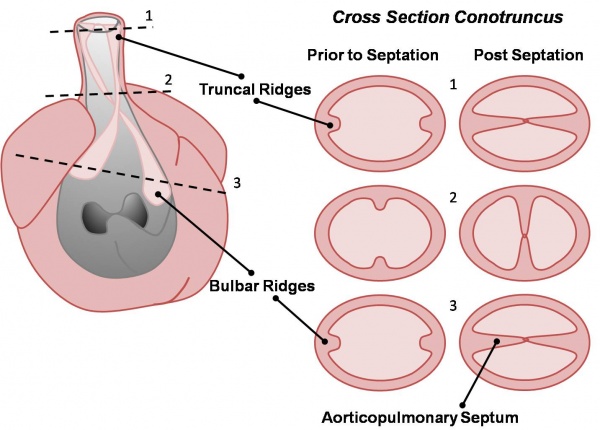
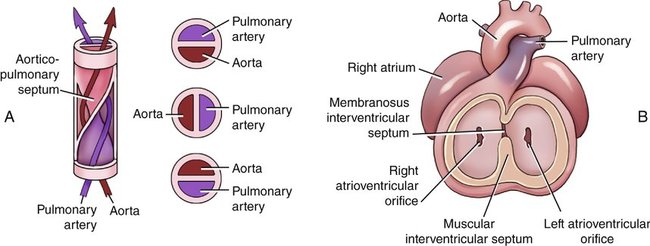
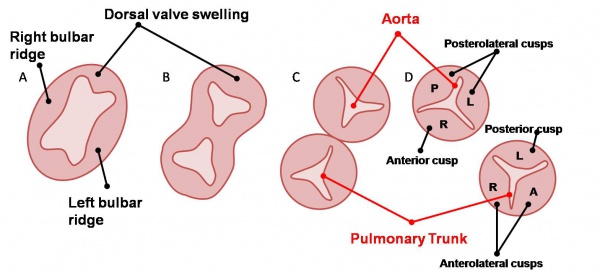
3. Distal part – Divided by spiral septum

  • Right and left major bulbar cushions develop
  • Descend to ventricles in a spiral course
  • Fuse to form aortic pulmonary septum to form pulmonary trunk and ascending aorta
Image result for right and left major bulbar cushions
Image result for aorticopulmonary septum

4. Development of IV septum

1. Muscular part:

  • Arises from floor of bulboventricular chamber
  • Crescent shape, grows cranially
  • Anterior horn fuses with ventral root of bulbus cordis
  • Posterior horn fuses with septum intermedium

2. Membranous part:

Proliferation of:

  • Right and left major bulbar cushions
  • Anterior and posterior endocardial cushions
Image result for development of IV septum

5. Development of aortic and pulmonary semilunar valves

Location: Junction of truncus arteriosus and bulbus cordis

Source:

  • Right and left major bulbar cushions – fuse to form aortic pulmonary septum
  • Anterior and posterior minor bulbar cushions – arise perpendicular to above
Image result for development of aortic and pulmonary semilunar valves

Before rotation:

Aorta:

  • 1 posterior aortic cusp – from posterior minor bulbar cushion
  • 2  anterolateral  aortic cusps – from the major bulbar cushions

Pulmonary trunk:

  • 1 anterior cusp – from anterior minor bulbar cushion
  • 2 posterolateral cusps – from the major bulbar cushions

After rotation of heart to left, the adult cusp postions:

Aorta:

  • 1 anterior cusp
  • 2 posterolateral cusps

Pulmonary trunk:

  • 1 posterior cusp
  • 2  anterolateral cusps

Anomalies of semilunar valves:

  • Pulmonary stenosis – ductus arteriosus remains open
  • Aortic stenosis  – ductus arteriosus remains open

Anomalies of position of heart:

  • Dextrocardia – mirror image. If many organs are also mirror images, known as situs inversus totalis
  • Ectopic cordis – defect in sternum, fails to close in midline, heart exposed to thorax surface

Anomalies of truncus arteriosus:

  • Fallot’s teratology:
  1. Most common anomaly of heart
  2. Pulmonary stenosis
  3. Cause hypertrophy of right ventricle
  4. Ventricular septal defect
  5. Overriding aorta receives blood from right and left ventricles
Image result for fallots teratology
  • Persistent truncus arteriosus – failure to develop AP septum, accompanied by ventricular septal defect and overriding aorta
  • Transposition of aorta and pulmonary trunk – AP septum runs straight instead of spiral course, aorta opens in right ventricle and pulmonary trunk opens in left ventricle. ductus arteriosus remains open to carry O2 blood to aorta

Amnion, Umbilical cord, Yolk sac and Allantois

Amnion

Made of amnioblasts and somatopleuric layer of extraembryonic mesoderm

The connecting stalk is only made of extraembryonic mesoderm

The amnion cavity obliterates extraembryonic coelom

Amniotic sac

Functions of amniotic fluid (made from amnioblasts and fetal urine):

  1. Cushions the baby
  2. Develops the suckling reflex
  3. Space for urine discharge
  4. Maintains constant temperature
  5. Antiseptic – cleanses vagina when the water breaks
  6. Allows movement of embryo – muscle development
  7. Bag of waters – dilates cervix gently

Abnormalities:

  1. Oligohydramnios – less amniotic fluid, adhesion of embryo to itsself and the amnion
  2. Polyhydramnios – more amniotic fluid, premature rupture

Umbilical Cord

Tubular sheath of amnion from placenta to umbilicus (naval)

Development of the cord:

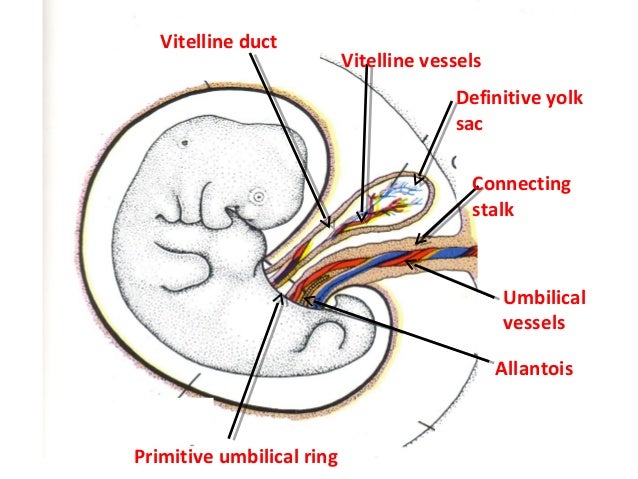
1. Primitive umbilical ring – line of reflection between amnion and ectoderm

Image result for primitive umbilical ring

2. Primitive umbilical cord

  • Body stalk
  • Yolk sac
  • Part of allantois (later in the chapter)

3. Definitive umbilical cord

  • Wharton’s jelly (mucoid substance from extraembryonic mesoderm)
  • 2 umbilical arteries
  • 1 umbilical vein
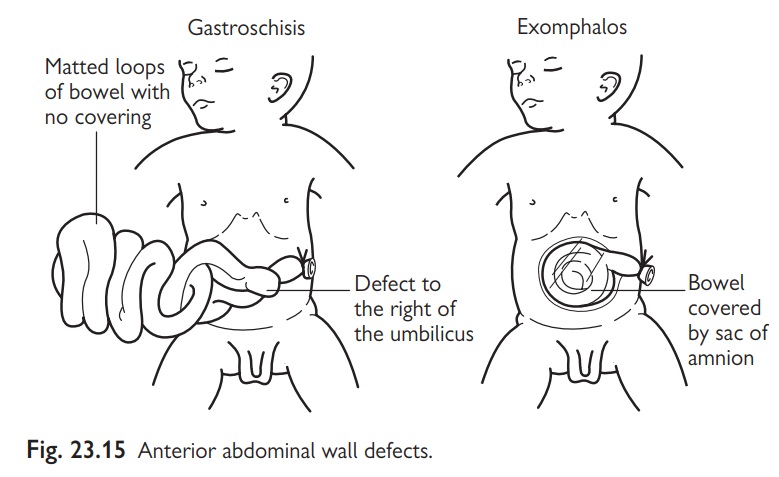
  • Physiological hernia between 6th and 10th week

Abnormalities:

  • Short cord
  • Long cord – can wrap around fetus neck
  • Exomphalos – failure to reduce physiological umbilical hernia
gastroschisis
exomphalos

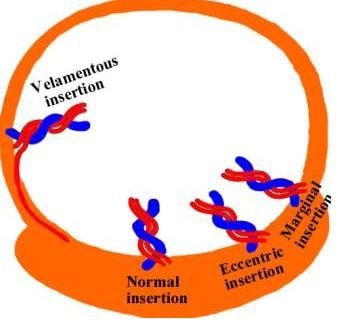
  • Attachment to placenta can be eccentric, marginal or velamentous (surrounding fetal membranes)
Image result for velamentous
placenta attachments - eccentric, marginal, velamentous
  • One umbilical artery instead of two
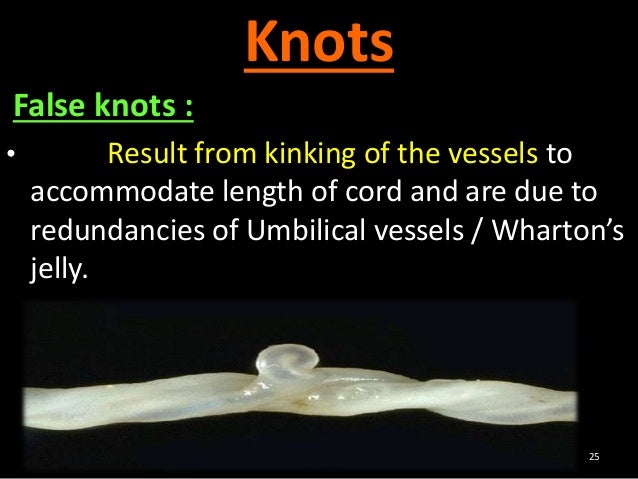
  • False knots
umbilical cord knot
  • True knots – dangerous, obstruct blood flow
  • Two to three umbilical cords

Yolk Sac

1. Primary yolk sac – Heusers membrane

2. Secondary yolk sac – Extraembryonic coelom

3. Folding of embryonic disc – primitive gut and definitive yolk sac

The embryonic disc folds in a cranial-caudal and lateral direction, because the central area of the disc grows more then the periphery. This results in the incorporation of the yolk sac roof into the embryo forming the primitive gut which is divided into foregut, midgut and hindgut.

The part of the yolk sac which was not incorporated is known as definitive yolk sac and is connected to the primitive gut by vitellointestinal  duct at the midgut.

Vitelline vessels – network of vessels develop in splanchnopleuric mesoderm covering the secondary yolk sac

Functions of yolk sac:

  1. Roof forms primitive gut
  2. Caudal end forms allantois
  3. Gives primordial germ cells which migrate to developing gonads
  4. Some vitelline vessels form embryonic vessels

Allantois

Allantoic vessels form the umbilical artery and vein

It’s a tubular invagination of the secondary yolk sac

It has 2 parts:

1. Intraembryonic part: forms  urachus which connects urinary bladder to umbilicus. After birth, the urachus is obliterated to form median umbilical ligament

2. Extraembryonic part: obliterated

Image result for allantois

Placenta

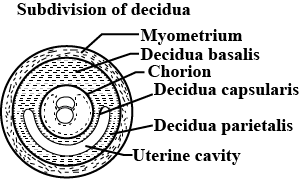
After implantation, the endometrium is known as decidua. 

Three types of decidua:

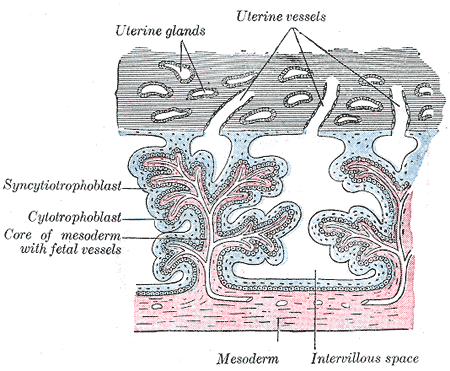
  • Decidua basalis – forms maternal part of placenta
  • Decidua capsularis – degenerates
  • Decidua parietalis – degenerates
Subdivisions of decidua

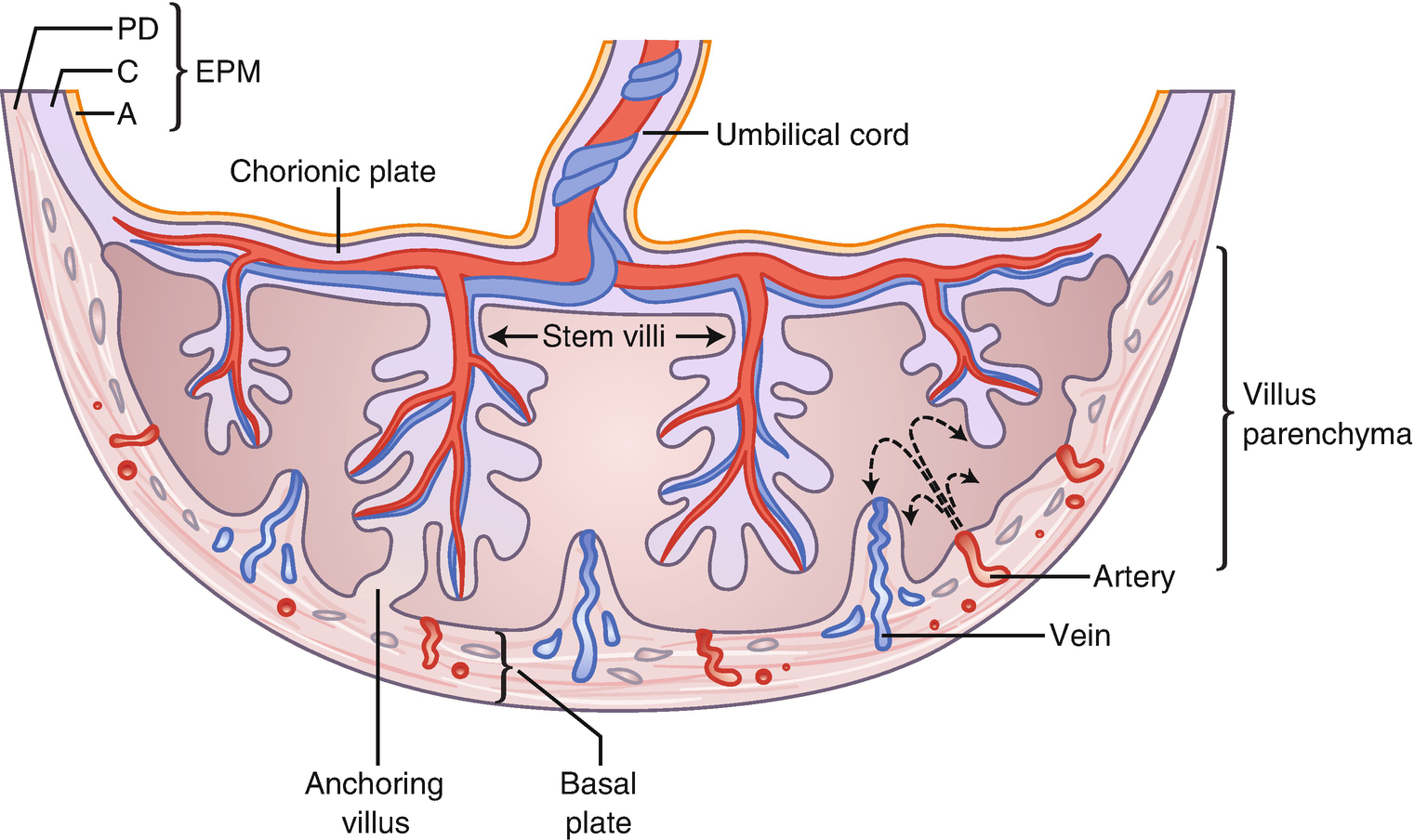
The chorionic villi over the embryonic pole remain and develop to form numerous villi. That part is known as chorion frondosum and is the fetus part of placenta.

The remaining part of the chorionic vesicle has no villi and is known as chorion laeve.

Placenta: Chorion frondosum and decidua basalis


Placental barrier: separates fetal and maternal blood and is made of:

1. Early pregnancy

  • Capillary wall
  • Extraembryonic mesoderm
  • Cytotrophoblast
  • Syncytiotrophoblast

2. Late pregnancy

  • Capillary wall
  • Syncytiotrophoblast

Placenta increases in thickness due to villi elongation, intervillus space increases

Placenta increases in diameter due to secondary growth of uterine wall


Functions of placenta:

  1. Nutrition
  2. Respiration
  3. Excretion
  4. Protective
  • Prevents most microorganisms
  • Antibodies transmitted
  • Prevents blood from mixing

5. Secretory

  • Progesterone
  • Estrogen (make uterus sensitive to oxytocin hormone)
  • Gonadotropic hormones

Clinicals:

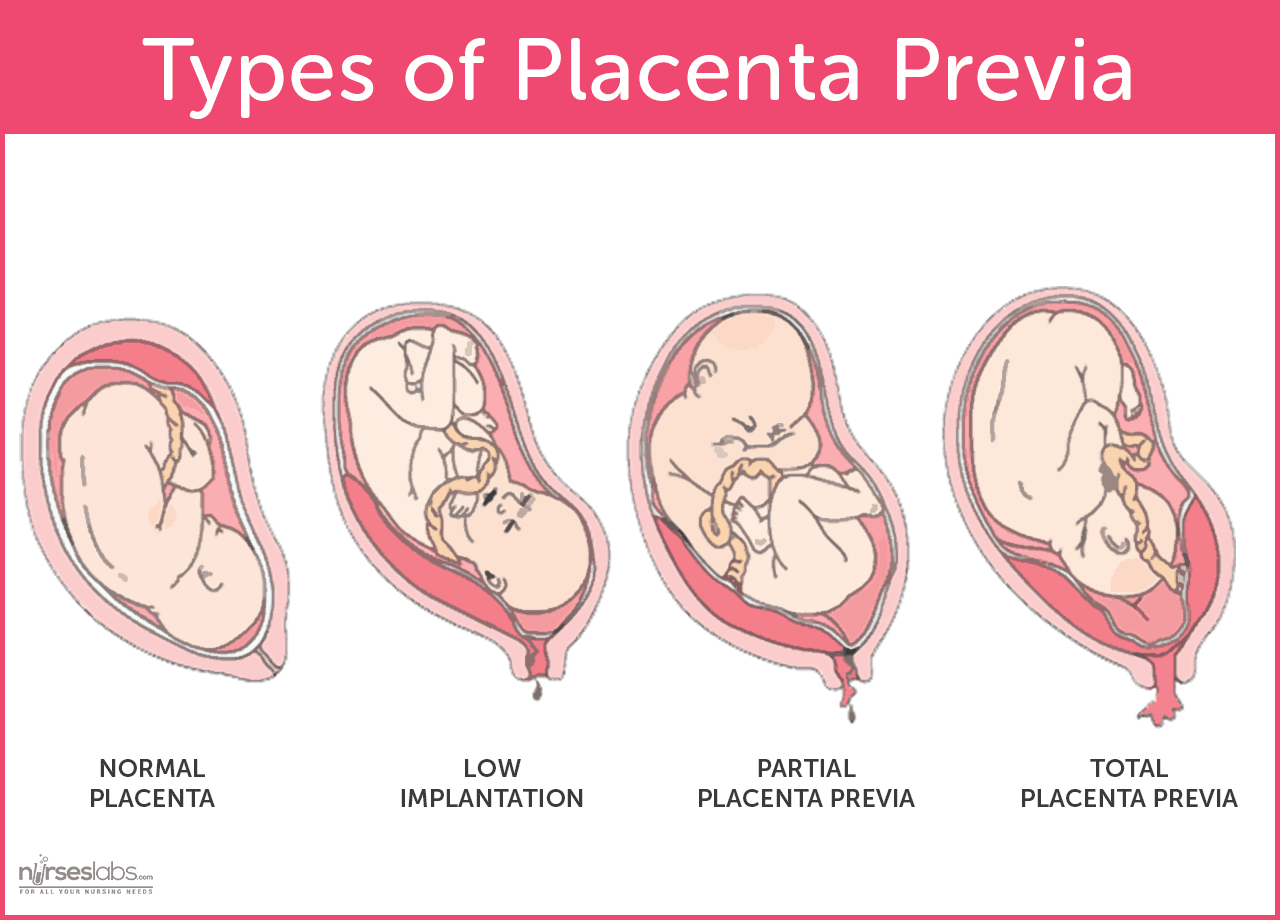
1. Placenta previa – implantation occurs in lower part of uterus

Image result for placenta previa lateralis
Types of placenta previa

2. Diffuse placenta – placenta lines greater part of uterine cavity

3. Bidiscoid placenta – placenta has 2 disc like equal parts, where each receive a branch from the umbilical artery

4. Accessory placenta – placenta has accessory lobes separate from the main placenta

Accessory placenta

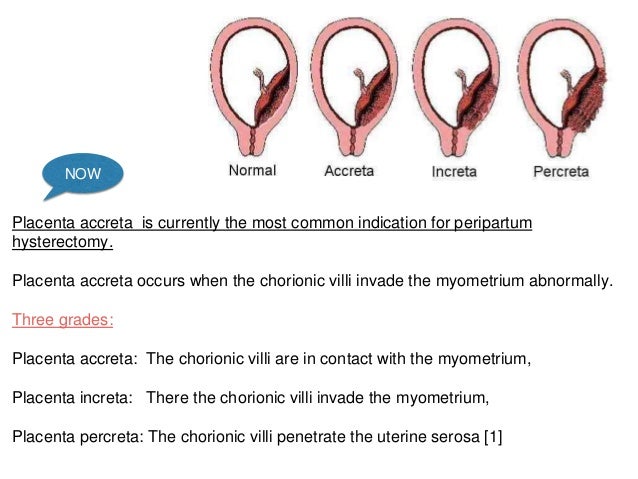
5. Placenta accreta, increta or percreta – placenta too deeply attached to uterus

Image result for placenta accreta, increta, percreta

Neural Tube

Formation of neural tube:

  1. Ectoderm over notochord thickens – forms neural plate (from primitive node to buccopharyngeal membrane)
  2. Neural groove appears and deepens
  3. Neural folds grow towards each other medially and fuse at the 4th somite
  4. Fusion continues cranially and caudally forming neural tube
  5. Edges of neural tube form neural crests
  6. Cranial neural pore closes at 20th somite stage
  7. Caudal neural pore closes at 25th somite stage

Neural tube forms brain and spinal cord

Image result for neural tube formation

Ectoderm and Endoderm derivatives

Ectoderm

  1. Neural tube – Nervous system ie. brain, spinal cord, arachnoid and pia matter
  2. Sensory epithelium of sensory organs
  3. Pituitary gland
  4. Medulla of suprarenal gland
  5. Lining of anterior oral cavity and lower anal canal
  6. External auditory meatus and outer tympanic membrane (ear drum)
  7. Epidermis of skin

Endoderm

1. Epithelial lining of:

  • Respiratory tract
  • GIT tract except anterior oral cavity
  • Urinary bladder except trigone
  • Urethra
  • Eustachian tube

2. Parenchyma of:

  • Tonsils
  • Thyroid
  • Parathyroid
  • Thymus
  • Liver
  • Pancreas


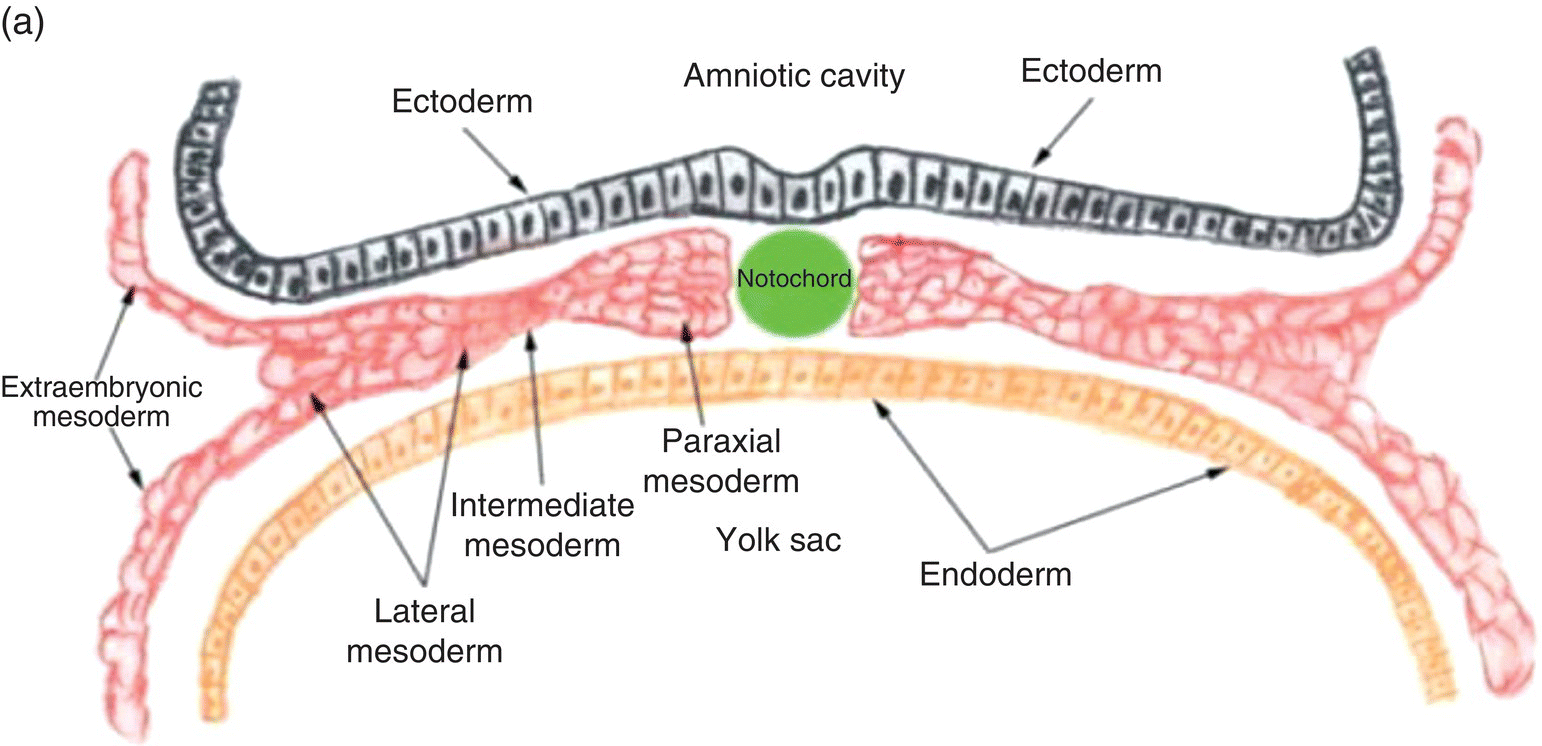
Paraaxial, intermediate, lateral plate mesoderm

The intraembryonic mesoderm differentiates into:

  1. Paraaxial mesoderm
  2. Intermediate mesoderm
  3. Lateral plate mesoderm
Image result for intraembryonic mesoderm

Paraaxial mesoderm

Transverse grooves appear dividing it into somites, from cranial to caudal end.

42 to 44 somites form;

  • 4 occipital
  • 8 cervical
  • 12 thoracic
  • 5 lumbar
  • 5 sacral
  • 8 – 10 coccygeal
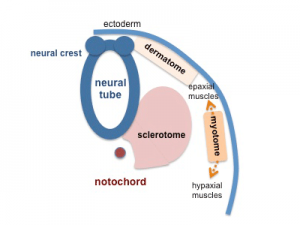
Somites

The somites then differentiate in a cranio-caudal direction into:

Image result for differentiation of somites
  1. Sclerotome – forms connective tissue, cartilage cells and bone cells of axial skeleton 
  2. Myotomes – differentiate into myoblasts, which then forms skeletal muscles of the body
  3. Dermatome – forms dermis of skin

Intermediate mesoderm

  • Cervical – segmented
  • Thoracic – partially segmented
  • Lumbar – unsegmented. forms nephrogenic cord (source of urinary system)

Origin to:

  • Cortex of suprarenal gland
  • Nephrons
  • Gonads

Lateral plate mesoderm

Image result for lateral plate mesoderm

Due to formation of intraembryonic coelom, it is divided into:

1. Somatic layer:

  • Adherent to ectoderm
  • Forms muscles and connective tissue of body wall

2. Splanchnic layer:

  • Adherent to endoderm
  • Forms serous membranes: Pleura, Pericardium, Peritoneum
  • Smooth muscles
  • Connective tissue of GIT, respiratory tracts
  • Cardiovascular system

The intraembryonic coelom forms:

  • Pericardial cavity
  • Peritoneal cavity
  • Pleural cavity

Other derivatives of the mesoderm:

  • All skeletal, smooth and cardiac muscles
  • Bone marrow and blood cells
  • Spleen
  • Lymph nodes
  • Dura matter

3rd week of pregnancy

In the 3rd week:

  1. Intraembryonic mesoderm forms
  2. Notochord forms
  3. Chorionic villi form

Intraembryonic mesoderm

This results in the formation of trilaminar germ disc from bilaminar germ disc. This is known as gastrulation

Gastrulation results in the formation of :

  1. Ectoderm (faces amniotic cavity)
  2. Mesoderm
  3. Endoderm (faces yolk sac)

In summary:

  1. Ectodermal cells in caudal end of bilaminar germ disc
  2. Form primitive streak, growing cranially
  3. Ectodermal cells insinuate themselves between ectoderm and endoderm
  4. Forming the intraembryonic mesoderm

Formation of notochord

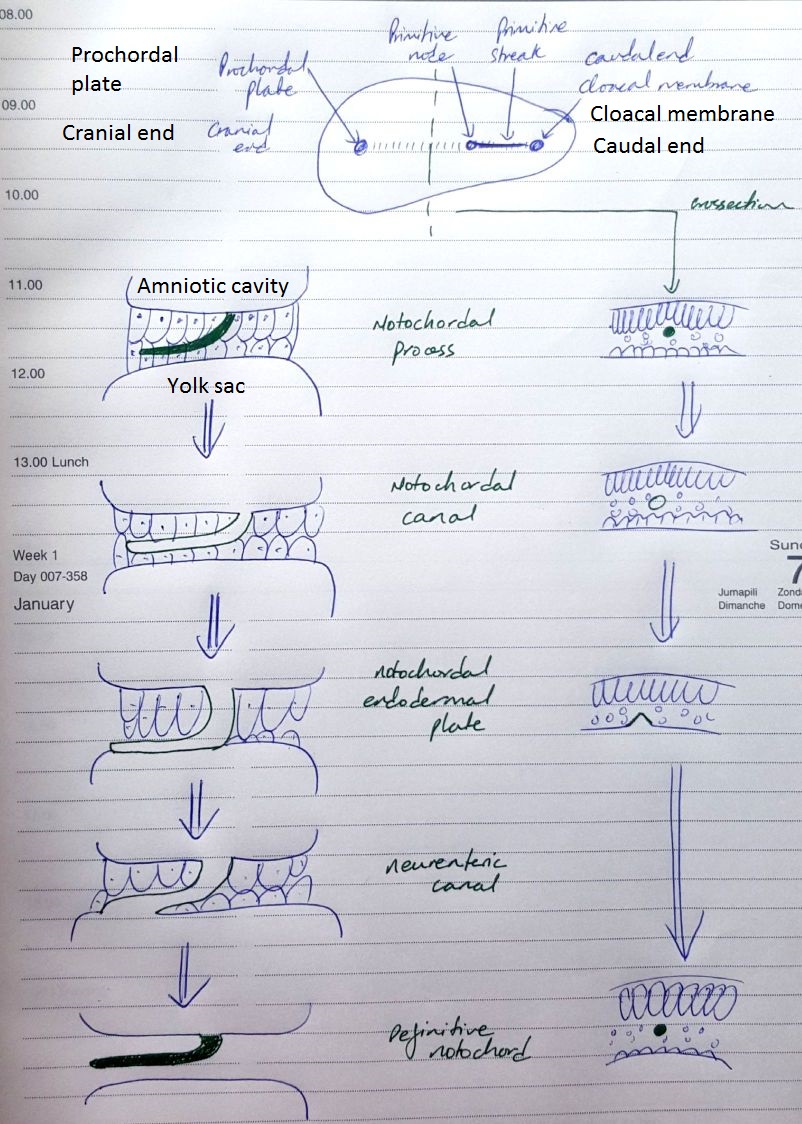
  1. Primitive node and primitive pit form – thickening of ectoderm at the cranial end of primitive streak, where a pit forms in the middle
  2. Cells proliferate and a solid rod of cells grows in cranial direction between ectoderm and endoderm – known as notochordal process
  3. Notochordal process canalizes to form notochordal canal
  4. Notochordal canal fuses with underlying endoderm to form notochordal endodermal plate
  5. Which breaks down to form neurenteric canal – temporary connection between amniotic cavity and yolk sac
  6. Remaining part of notochordal plate folds along longitudinal axis. forms a solid rod of cells, known as definitive notochord
  7. Acts as a temporary axial skeleton

Formation of notochord

In summary

  1. Primitive node and primitive pit
  2. Notochordal process
  3. Notochordal canal
  4. Notochordal endodermal plate
  5. Neurenteric canal
  6. Notochordal plate folds
  7. Definitive notochord

NB: The midline region, prochordal plate and cloacal membrane do not contain mesodermal cells and remain bilaminar.

The prochordal plate will later become the buccopharyngeal membrane (oral membrane)

Formation of chorionic villi

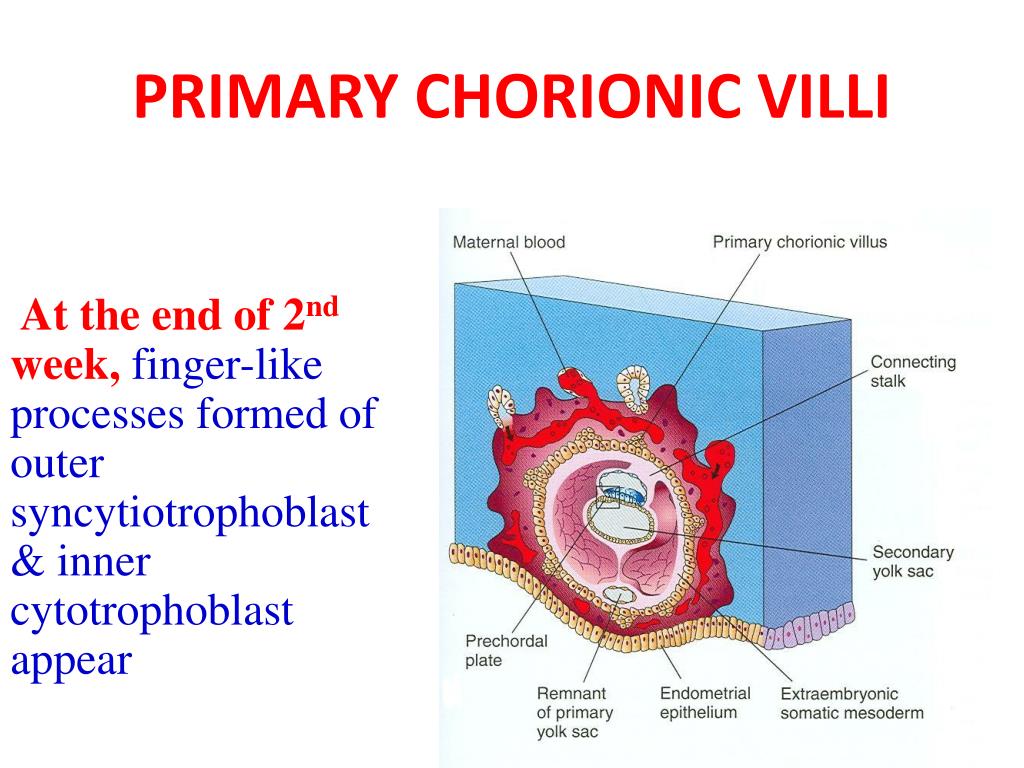
  1. Primary villi: Syncytiotrophoblast – cytotrophoblast
  2. Secondary villi: Syncytiotrophoblast – cytotrophoblast – extraembryonic mesoderm
  3. Tertiary villi: Syncytiotrophoblast – cytotrophoblast – extraembryonic mesoderm – afferent and efferent capillaries

Primary chorionic villi

There are two types of villi:

  • Anchoring villi – penetrates into decidua basalis and anchor chorion vesicle to wall of uterus
  • Absorbing villi – branches in intervillus space

Image result for primary chorionic villi

Anchoring villi:

Anchoring villi